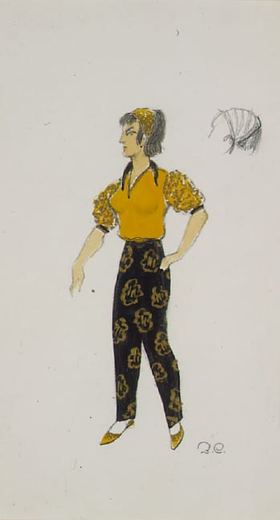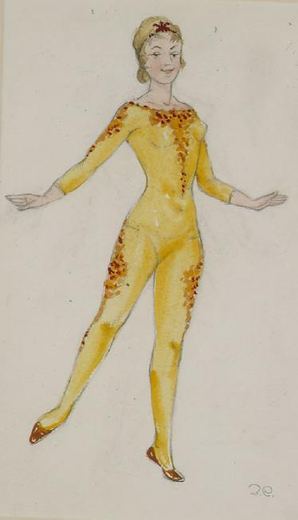
Ballerina in Yellow Tights
Zinaida Markovna Sirvint-Sherman / Shirvint-Sherman
1950 · Pencil and watercolor on paper · 18 x 30 cm
Zinaida Markovna Sirvint-Sherman is one of those artists of Soviet modernism whose work long remained more visible in archives, theatre holdings and private collections than in the broader art-historical consciousness. Her significance lies less in classical easel painting than in theatre and design art: costume, stage, book design and graphic conception. Precisely for this reason, she is of interest to a sophisticated collection of Russian art. She makes visible that Russian-Soviet modernism did not take place only on canvas, but also in theatre workshops, printed matter, costume designs and applied pictorial spaces. The source base for Sirvint-Sherman is fragmentary, but meaningful on several points.
She is listed as a theatre artist and designer, studied in the VKhUTEMAS environment under Aristarkh Lentulov and, in the late 1920s, was connected with artists' groups such as the Guild of Painters and the Moscow Association of Decorative Artists. This constellation is art-historically important: Lentulov belonged to the formative representatives of Russian Cubo-Futurism and early modernism, while the decorative artists' associations of the 1920s shaped the visual language of theatre, exhibition practice and the new Soviet public sphere. Sirvint-Sherman's surviving and market-documented works are primarily theatre and costume designs. These sheets concentrate the visual culture of a period in which stage and costume were understood as laboratories of modernity. A design is not merely preparation for a performance, but an independent artistic document.
Figures are characterised through silhouette, colour, material quality, posture and ornamental signs. For theatre designs of the 1920s and 1930s, this union of function and pictorial force is central. It is important neither to overstate Sirvint-Sherman artificially nor to underestimate her. Women artists and theatre designers of this generation often remained less visible in general art history than painters represented in major museum halls. A collection that presents Russian art seriously and with nuance includes precisely such positions: they reveal the breadth of the art system and the importance of applied and performative arts. Sirvint-Sherman therefore stands for an archive of Soviet stage modernism. Her work mediates between avant-garde training, practical theatre work and the pictorial independence of design.
For art-interested viewers, her profile opens access to a less familiar but decisive question of modernism: how was the human figure reinvented on stage, in costume and in graphic preparatory drawing?
Sirvint-Sherman's work is best approached through costume and stage designs. Central are line, silhouette, bodily posture and the translation of literary or dramatic roles into visual signs. Her works belong to the context of a Soviet theatre culture in which designs can be read as independent works of graphic art. The connection with VKhUTEMAS and Lentulov suggests an affinity with expressive form, constructive simplification and intensified colour. For individual works, however, dating and attribution to specific productions always be checked separately, since many surviving sheets come from dispersed archives and estates.
For I tesori della Russia, Sirvint-Sherman is especially relevant because she expands the collection into the dimension of theatre and design art. She prevents too narrow a definition of Russian art as pure painting and shows how strongly modernism in Russia was shaped by stage, graphic art, costume and applied arts. For a demanding audience, her profile can be convincing precisely because it makes visible a rarer, archivally interesting position.