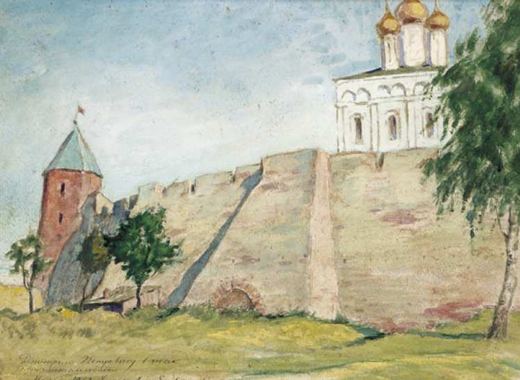
Kremlin of an Ancient City
Eugene Lanceray; Evgeny Evgenievich Lanceray
1932 · Watercolor on cardboard · 39 x 29 cm
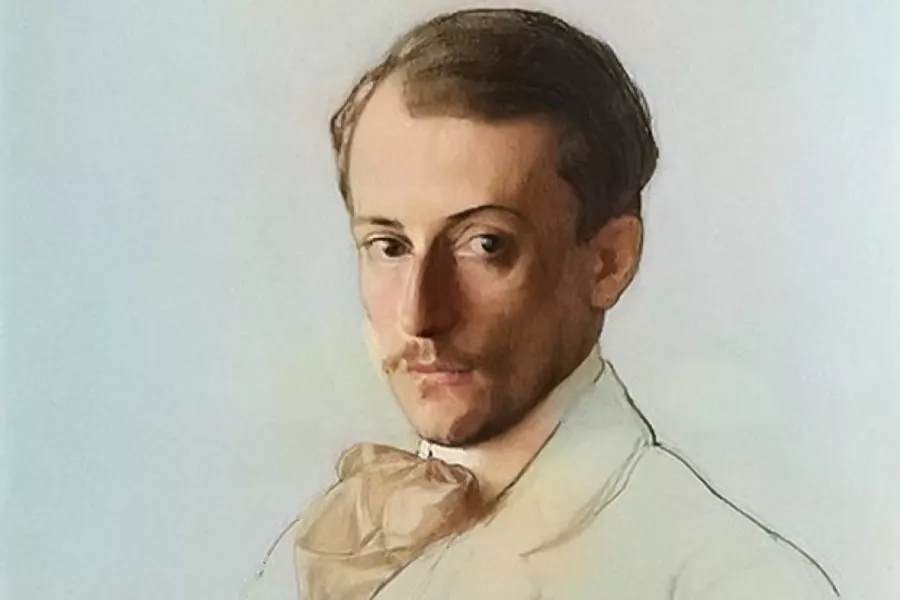
Jewgenij Jewgenjewitsch Lansere is one of the most multilayered figures of Russian art between the Silver Age and the Soviet period. As a painter, graphic artist, book artist, stage designer and muralist, he combined historical imagination, decorative culture, precise drawing and an exceptional sense of narrative pictorial organisation. He came from the celebrated Benois-Lansere family of artists: his father was the sculptor Evgeny Alexandrovich Lanceray, his sister Zinaida Serebriakova and his uncle Alexandre Benois. This was not merely a biographical background, but a milieu in which art, architecture, theatre, collecting and historical education were understood as a connected culture. Lansere trained in Saint Petersburg and Paris and was early associated with the Mir Iskusstva movement.
Like many artists of this group, he treated history not as dry academic reconstruction, but as an aesthetic space that could be brought to life. Russian history, Baroque courts, architecture, ceremonial culture, old cities and literary subjects appear in his work not as inert documents, but as staged and dramaturgically organised visual worlds. His illustrations, vignettes and historical sheets reveal a culture of line that is elegant, controlled and narratively dense. After the Revolution, Lansere remained active within the Soviet cultural sphere and developed his work toward monumental, decorative and historically political commissions. He is therefore an important artist of transition. On the one hand, he belongs to the pre-revolutionary Petersburg culture of the Silver Age; on the other, he entered Soviet art institutions with their new subjects and representative tasks.
This continuity across a historical rupture makes him especially significant: he shows how an aristocratically educated, European-oriented culture of drawing and theatre could be translated into new Soviet formats. For I tesori della Russia, Lansere is a key artist for understanding Russian art as a total culture. He stands not only for individual images, but for book, stage, illustration, architectural fantasy and historical memory. His inclusion allows the collection to tell a sophisticated story of Russian modernity beyond the narrow opposition of avant-garde and realism. Lansere embodies a third, highly cultivated line: historical imagination, graphic elegance and scenic construction.
Lansere worked with a precise, cultivated line and a strong scenic organisation of the pictorial field. His art lives from historical atmosphere, architectural order and decorative intelligence. In graphic art, book design, theatre and monumental painting he joins narrative clarity with high stylistic consciousness. Art-historically he stands between Mir Iskusstva, retrospectivism and Soviet history painting.
The source list records an extensive group of works by Lansere with historical and literary themes, including Tsarskoye Selo, Peter the Great, Tolstoy's Hadji Murat, the construction of Moscow and the series on Russian military trophies. For I tesori della Russia, he is therefore an ideal position for presenting Russian art as a connection between history, illustration, theatre and state memory culture.