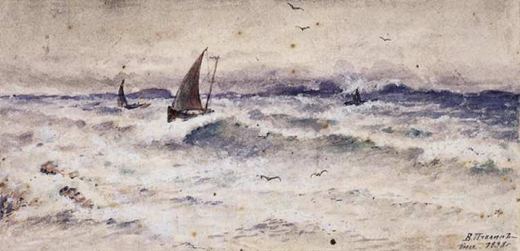
The Return of the Fishermen
Vladimir Nikolaevich Pchelin
1898 · Watercolor on paper · 20 x 10 cm
Vladimir Nikolaevich Pchelin is an artist of transition. His biography and his work lead from the realistic genre painting of the late imperial period into the historical-revolutionary visual culture of the early Soviet era. This makes him especially interesting for a collection of Russian art: he shows not only a style, but a historical shift. His work makes it possible to trace how an artist trained in the tradition of the nineteenth century took up new political subjects and new public functions of painting after 1917. Pchelin was born in 1869 in Kyiv. His family connection with the Tyranov family of artists shaped his early access to art. He studied at the Moscow School of Painting, Sculpture and Architecture and later at the Imperial Academy of Arts, including in the circle of Ilya Repin.
This training connected Moscow Realism, disciplined drawing and the narrative strength of Russian genre painting. As early as 1892, the painting Young People at the Father-in-Law's brought him attention; the work was acquired for Pavel Tretyakov's collection. This early recognition anchored Pchelin in the realist art culture of his time. Before the Revolution, Pchelin worked as a genre and landscape painter. His pictures belong to a tradition of art that narratively records social scenes, everyday life, types and rural or urban milieus. After 1917 his thematic field changed markedly. He turned to historical and revolutionary subjects and became known for works such as The Execution of Alexander Ulyanov and depictions of Soviet mass and state events. In 1926 he received the title Honoured Artist of the RSFSR; in 1934 he was named Honoured Art Worker of the RSFSR.
This development makes Pchelin an illuminating figure in art history. He is neither a radical avant-gardist nor merely an academic painter. Rather, he shows how Russian Realism could be transferred into a new political image system. The capacities of the nineteenth century - composition, figure, narration and the clearly legible moral scene - were redeployed in the Soviet context. Genre painting became revolutionary history painting; civic-realist observation became an instrument of state-compatible memory culture. For contemporary interpretation, it is important to present Pchelin with differentiation. His Soviet subjects are not neutral, but part of an ideological production of images. At the same time, his artistic development is not reduced to propaganda.
He embodies a generation that worked in two political systems and whose art makes visible the rupture between empire, revolution and Soviet state formation.
Pchelin's work is characterised by narrative clarity, solid figural composition and a realist attention to milieu and action. In the early genre paintings, social situations, family scenes and everyday motifs stand in the foreground. The painting follows the tradition of Russian realists who understood the picture as a readable scene. After the Revolution, a more historical and political order enters the work. The compositions become more public, thematically more explicit and more strongly related to collective memory. Precisely this shift makes his work an important document of the transformation of Russian art from the late nineteenth into the early twentieth century.
For I tesori della Russia, Pchelin is important because he makes visible the transition between two epochs. Within the collection he can serve as a link between realist-academic training, the Tretyakov tradition and Soviet history painting. His profile helps explain the historical complexity of Russian art after 1917 without simplifying it.