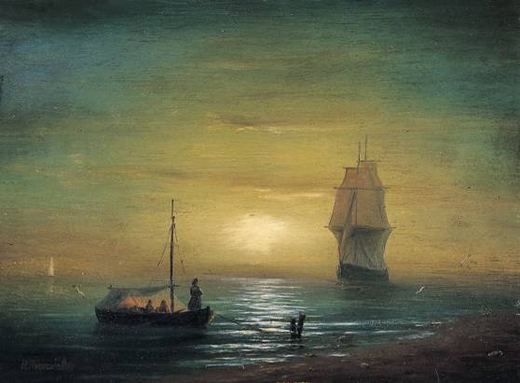
Tsar Peter the Great Observes the Foreign Ship Entering the Port
Vyacheslav Pavlovich Bychkov
1896 · Oil on wood panel · 18 x 12 cm
Vyacheslav Pavlovich Bychkov is a Russian-Soviet painter and graphic artist whose work is situated between late Realism, the Moscow school of painting and early Soviet art. He is not among the most widely canonised names of Russian art, but he is significant for a differentiated collection because he makes visible the breadth of realist painting after 1900. His biography connects regional origin, academic-practical training, membership in artists' associations, pedagogical work and a sustained engagement with landscape and everyday life. Bychkov was born in 1877 in Yaroslavl into a merchant family. He received his first artistic foundations in the municipal drawing classes of Yaroslavl under P. A. Romanovsky. In 1896 he entered the Moscow School of Painting, Sculpture and Architecture, one of the most important training centres of Russian realist art.
His teachers included Konstantin Gorsky, Abram Arkhipov, Nikolai Kasatkin, Leonid Pasternak, Sergei Miloradovich and, later, Valentin Serov and Konstantin Korovin. This list of teachers is art-historically revealing: it connects the realist narrative tradition, painterly loosening, Impressionist colour experience and a modern conception of study from nature. In 1908 Bychkov graduated from the school with the title of class artist. In the years around 1903 to 1920 he often worked on the Volga, especially in the area of Kineshma. For many Russian artists, the Volga became a culturally charged landscape and life-world: a traffic artery, a popular space, a commercial world, a natural motif and a symbol of national breadth. Bychkov's works from this environment combine landscape, everyday life and atmospheric observation. After the Revolution, Bychkov was institutionally active.
From 1919 he worked in the commission for the protection of art and antiquities under the Moscow Soviet and took part in the organisation of the Third Proletarian Museum. Later he was a member and exhibitor of the AChRR and a co-founder of the Association of Realist Artists. These stations show how artists of his generation did not simply disappear after 1917, but brought their realist training into new Soviet institutions. His pedagogical activity is also especially important. Bychkov taught drawing and technical drawing for many years in Moscow schools and, after the Second World War, within the Moscow regional art education system. He therefore stands not only for individual works, but also for the transmission of realist visual competence in Soviet artistic culture.
Bychkov's painting is realist, but not rigidly academic. His Moscow training with Serov and Korovin opened to him a painterly handling of light, colour and direct observation. His landscapes and genre scenes are often marked by a quiet, narrative atmosphere. They do not seek heroic monumentality, but recognisable life in landscape, market, river space and everyday experience. Art-historically, Bychkov represents the continuity of realist painting across the revolutionary divide. While the avant-garde developed radical forms and Socialist Realism later became the official norm, his career shows a pragmatic, institutionally embedded practice of realist art. Precisely such artists explain how broad and multifaceted the Russian-Soviet art landscape actually was.
For I tesori della Russia, Bychkov is relevant because he adds a realist, pedagogical and regional dimension to the collection. He shows a path from the Moscow School through the Volga landscape to Soviet artists' associations and museum initiatives. In a public catalogue, he appears as a representative of the generation of artists that continued the realist tradition within changed historical frameworks.