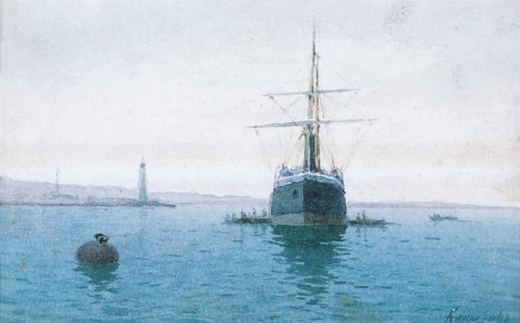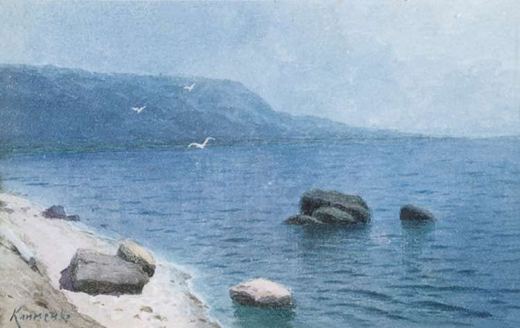
Seagulls
Viktor Ivanovich Klymenko / Klimenko
Watercolor on postcard · 13 x 8 cm
Viktor Ivanovich Klimenko, or Viktor Ivanovych Klymenko, is an important special case among the first ten artists of the collection. He does not belong to Russian art in the narrow national sense, but to twentieth-century Ukrainian art, whose training, institutions and themes long stood within the Soviet cultural sphere. A public catalogue does not blur this distinction, but use it curatorially. Klimenko broadens the view from “Russian art” to the complex artistic landscape of the former empire and the Soviet Union. Klimenko was born in the Donetsk region in 1932 and died in Cherkasy in 2022. He studied at the Kyiv Art Institute, graduating in 1964. The Encyclopedia of Modern Ukraine lists V. Kostetskyi, V. Puzyrkov and O. Syrotenko among his teachers. After his studies he worked in artistic-practical institutions in Dnipropetrovsk and Cherkasy, later as an independent artist.
From 2002 to 2015 he was a professor at Cherkasy University in the field of fine and decorative art. His work is strongly marked by historical themes. The Encyclopedia of Modern Ukraine identifies the liberation war under Bohdan Khmelnytsky as a leading theme of his art. Klimenko created historical, multi-figure compositions and portraits of historical personalities. This pictorial world is monumental, realistic and symbolically charged. It belongs to a tradition in which history is not only narrated, but set into images as collective identity. Klimenko's art requires careful classification. It does not stand in the line of the Russian Avant-Garde, but in the context of a Soviet-trained, Ukrainian national history painting. His compositions address memory, heroism, historical legitimacy and cultural self-assurance. Realism serves not only recognisability, but monumentalisation.
Figures become carriers of historical meaning; group compositions create a feeling of dramatic density and collective action. For a contemporary audience, this position is particularly relevant. It shows that the artistic spaces of Russia, Ukraine and the Soviet Union were historically closely interwoven, but not identical. A collection named I tesori della Russia does not level such border and neighbouring positions, but describe them transparently as part of a broader Eastern European and post-Soviet artistic fabric.
Klimenko's visual language is realistic, figure-oriented and often historical-monumental. Unlike more intimate portrait or still-life painters, he aims at large narrative structures. The body, the group and the historical scene become central bearers of meaning. His compositions work through clear legibility, dramatic concentration and symbolic significance. Art-historically, Klimenko is understood as a representative of a generation trained in the Soviet academic system after the Second World War, but one that developed regional and national themes further. His significance lies less in formal innovation than in the condensation of historical memory and in his institutional role as artist and professor in Cherkasy.
For I tesori della Russia, Klimenko possesses above all contextual strength. He is presented as a bridge to Ukrainian-Soviet artistic contexts and expands the collection by a historical dimension that is treated with political, cultural and regional sensitivity. This increases the seriousness of the catalogue: not everything is simplistically labelled “Russian”, but classified with precision. His profile is therefore formulated consciously differently from that of a Russian canon artist. The collection relevance lies in the historical entanglement of the Eastern European art field and in the question of how national history was visually processed within Soviet art institutions.