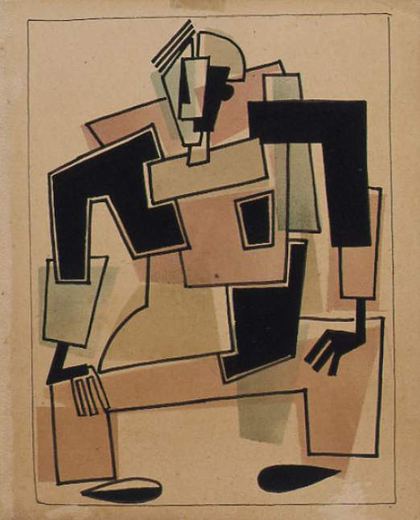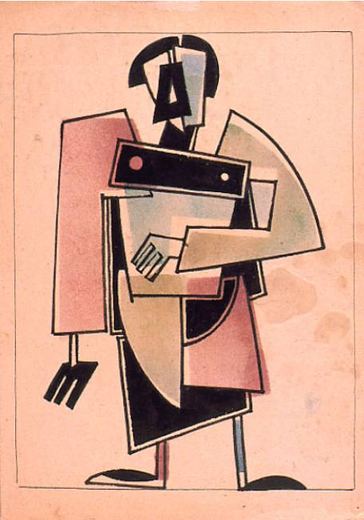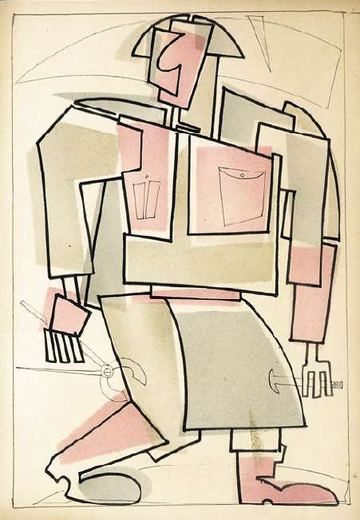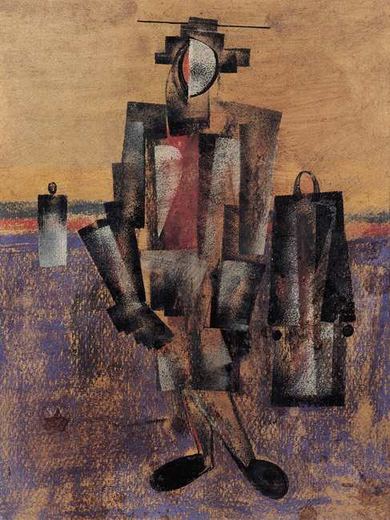
Three Figures
Vladimir Yevgrafovich Tatlin
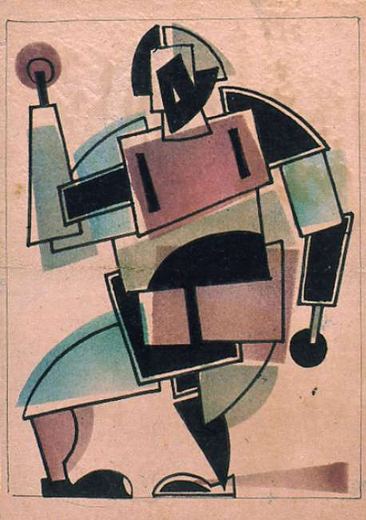
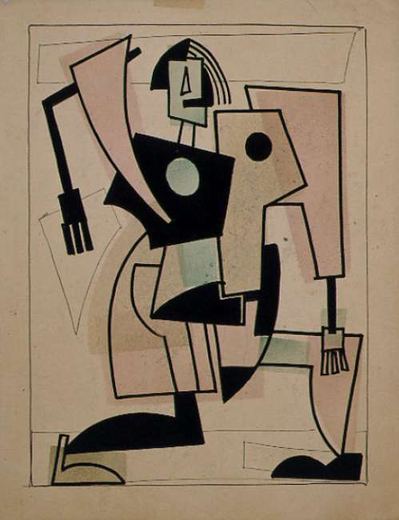
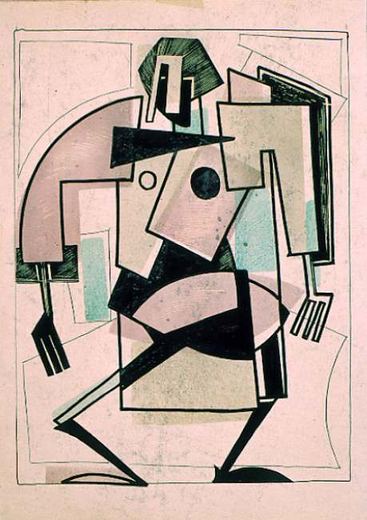
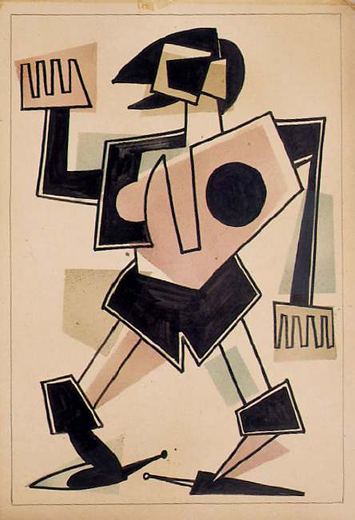
1917 · Pastel on paper · 24 x 32 cm
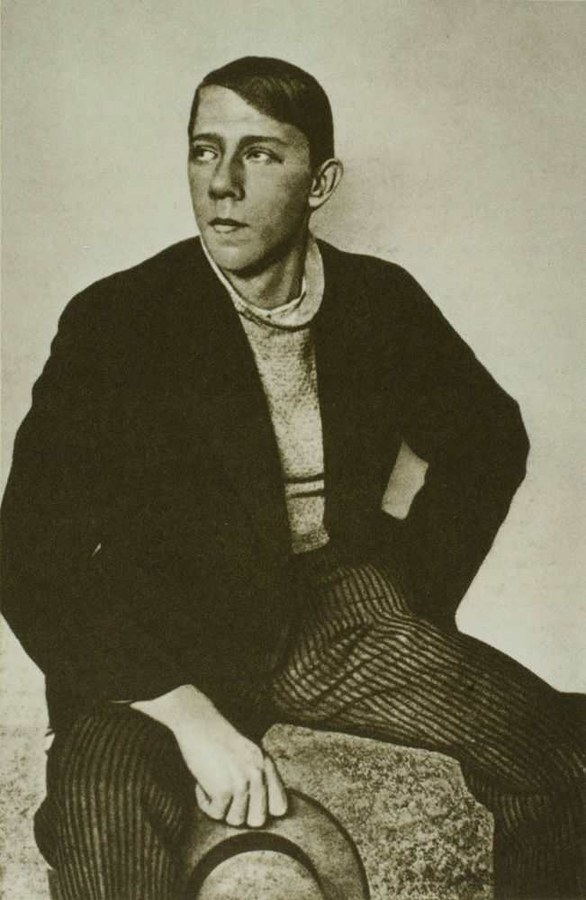
Vladimir Yevgrafovich Tatlin is one of the decisive figures of the Russian Avant-Garde and, at the same time, one of the artists who fundamentally expanded the concept of the artwork. While Malevich leads painting into the non-objective plane, Tatlin relocates the problem of modernism into material, construction, space and technical utopia. His work is less metaphysical than craft-based, less icon than structure. Tatlin thinks of art as built reality. Tatlin was born in 1885 in Kharkiv, today in Ukraine and then part of the Russian Empire. His biography is marked by movement: he studied in Moscow and Penza, worked as an icon painter, played the bandura, travelled at sea and came early into contact with highly diverse visual and material cultures.
This background explains one essential feature of his work: Tatlin is not an artist of pure theory, but an artist of the hands, of materials and of the tension between form and function. A key moment was his encounter with Picasso’s reliefs in Paris in 1913. After returning to Russia, Tatlin developed his so-called painterly reliefs and counter-reliefs. These works broke open the boundary between painting and sculpture. Wood, metal, glass, wire and other materials were no longer depicted illusionistically, but placed into space as real substances. The artwork became a construction of forces, weights, surfaces and tensions. Tatlin is therefore regarded as one of the pioneers of Constructivism, even if his own position is not identical in every respect with later Constructivist programmes.
The decisive point is that he no longer understood art as representation, but as the concrete organisation of material. This is one of the most radical shifts of modernism: the image is left behind, the plane opens into space, and the artist approaches the engineer, constructor and designer. His most famous project is the Monument to the Third International, the so-called Tatlin Tower. Designed in 1919/20, it was conceived as a revolutionary administrative and communications building: a gigantic spiral structure of iron and glass containing rotating geometric volumes. The project was never built, yet its significance lies precisely in its unrealised condition. Tatlin’s Tower became the image of a revolutionary future in which architecture, technology, politics and art were to merge. Tatlin later worked in stage design, applied design and on the flying apparatus Letatlin.
These works show that his interest in function, movement and corporeality was enduring. Tatlin is not only the artist of an iconic tower design, but a researcher into the relationship between human being, material and a new world.
Tatlin works with an emphatic concept of material. Whereas in traditional art wood, metal or glass often serve as carriers of illusion, in his work they become active elements. His art asks: what can material itself say? How does form arise from tension, weight, bending, construction and spatial relation? From this emerges an aesthetic that opens the way to object art, installation, design and modern architecture. Art-historically, Tatlin must always be considered in relation to Malevich. Both belong to the Russian Avant-Garde, yet they embody different poles: Malevich seeks the spiritual absoluteness of form, Tatlin the real organisation of material and function. In a collection, this opposition is extraordinarily strong because it makes visible the inner richness of Russian modernism.
For I tesori della Russia, Tatlin is a strategically important artist. He anchors the collection not only in the field of painting, but also in the history of the object, space, architectural utopia and modern design culture. His presence allows the Russian Avant-Garde to be told as a laboratory of modernism as a whole - not merely as a style, but as a redefinition of what art itself could be. Within the collection narrative, Tatlin is presented as the constructive counterpart to Malevich and the material-spatial counterpart to Lebedev. Together these artists show that Russian modernism consisted of several competing visions: image, book, poster, material, construction and utopia.