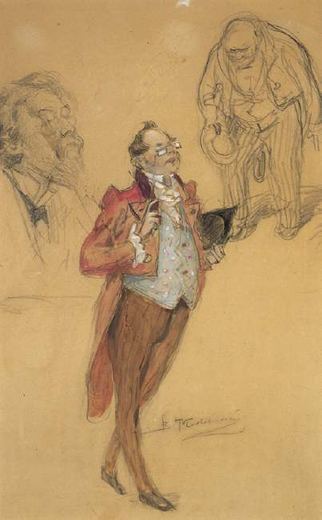
Gentleman with Blue Waistcoat
Wladimir Jegorowitsch Makowskij
Pastel on cardboard · 21 x 34 cm
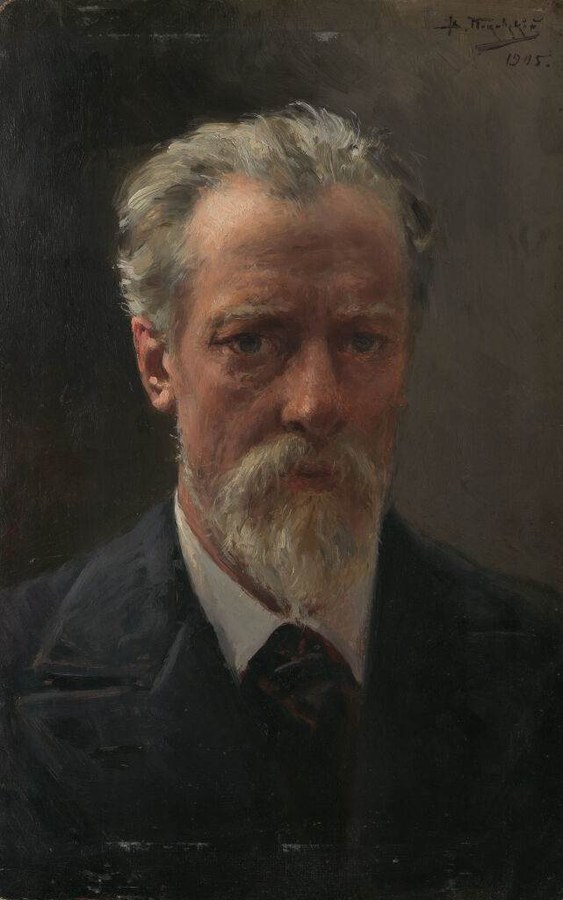
Vladimir Yegorovich Makovsky is one of the major representatives of Russian Realism and one of the defining painters of the Peredvizhniki, the Association of Travelling Art Exhibitions. Born in Moscow into a highly cultivated artistic family, he grew up in an environment in which music, literature, collecting culture and the visual arts were closely linked. His father, Yegor Makovsky, was among the founders of the Moscow art-school milieu from which the Moscow School of Painting, Sculpture and Architecture later emerged. His siblings Konstantin, Nikolai and Alexandra also became artists. Makovsky studied at the Moscow School of Painting, Sculpture and Architecture and developed early on a particular sensitivity to everyday life. In 1870 he became one of the founding members of the Peredvizhniki.
This movement opposed the limitations of academic exhibition policy and sought an art that made social reality, moral questions and the lives of different social strata visible. Within this movement, Makovsky became a master of the small, precisely observed scene. His paintings show children, families, officials, poor people, urban interiors, literary situations, market scenes, court scenes and episodes of daily life. Their decisive artistic value lies not in grand historical gestures, but in the ability to condense social atmosphere. Makovsky's figures are often psychologically exact; gestures, glances and spatial arrangement reveal tensions between poverty and dignity, humour and melancholy, private life and social order.
Makovsky's work is a core example of the narrative power of Russian genre painting. His pictorial language combines academically trained drawing with an almost literary sense of situation. Many of his paintings appear like condensed novellas: an interior, a conversation, an exchange of glances or a moment of childlike attention is enough to open an entire social story. Art-historical classification: Art-historically, Makovsky is placed between social Realism, moral observation and bourgeois pictorial culture. Unlike monumental history painters, he often works in the mode of observation. His proximity to nineteenth-century literature is unmistakable: like Russian prose writers, he is interested in the relation between individual, family, poverty, institution and conscience. As a teacher, he also shaped the next generation of Russian artists and helped institutionalise a realist understanding of the image.
For I tesori della Russia, Makovsky is a foundational position. He communicates to the art-interested public the social and moral horizon of late nineteenth-century Russian painting. While landscape painters such as Shishkin formed Russian nature as a national pictorial space, Makovsky translated everyday life into a precise, empathetic and at the same time critical art. A work by Makovsky in the collection is therefore presented as an example of the narrative intelligence of Russian Realism. His profile makes it possible to understand the Peredvizhniki not merely as an art movement, but as a cultural project: art make visible what constitutes society.