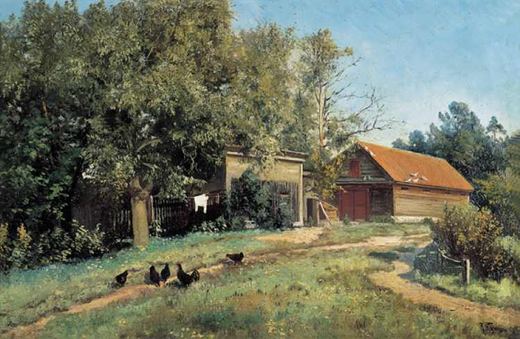
Country Courtyard
Wladimir Gawrilowitsch Kasantzew
Oil on canvas · 34 x 22 cm
Vladimir Gavrilovich Kazantsev was one of the early professional artists from Yekaterinburg and an important figure in the Ural landscape painting of the late nineteenth century. He came from a prosperous merchant and gold-industrialist family, first studied law at Moscow University and only later turned decisively to art. This biographical shift is significant: Kazantsev did not enter painting as the child of an artistic dynasty, but from a regional elite whose economic and cultural world was closely tied to the Urals. In 1880 Kazantsev went to Saint Petersburg and studied as a free student at the Academy of Arts, among others under Vladimir Orlovsky. In 1884 he graduated with the rank of class artist of the second degree; in 1891 he received the first degree, and in 1894 he was appointed Academician of Painting.
His artistic career therefore combined academic recognition with a strong regional orientation. The Urals in particular became his central pictorial space: rivers, forests, weather conditions, roads, remote places and northern light shape his visual world. Kazantsev's works are art-historically valuable because they show Russian landscape not only from the perspective of the centres Moscow and Saint Petersburg. In his work, the Urals appear as an independent cultural region between nature, industry, trade, religious tradition and regional identity. He thus substantially expands the understanding of Russian landscape painting.
Kazantsev's landscapes combine academically trained composition with a particular attention to regional atmosphere. The Academy of Arts names him as a painter active in Perm, Yekaterinburg, Saint Petersburg and Poltava; his biography includes theatre decoration as well as painting. This coexistence of landscape and stage is revealing: even the landscape can take on a staged quality in his work without abandoning observation of nature. Art-historical classification: Known work lists include motifs such as forest paths, river landscapes, frosty nights, views of the Urals and autumnal compositions. The title of Academician, awarded in 1894 for the painting Falling Leaves, shows the recognition of his ability to connect natural mood with pictorial composition. Kazantsev thus stands for a regional, yet academically legitimised form of Russian landscape painting.
For I tesori della Russia, Kazantsev has considerable curatorial importance because he extends the geographical and cultural horizon of the collection to the Urals. He shows that Russian art was not created only in the capitals, but also in regional image-worlds that generated their own subjects and visual identities. The link to the Irkutsk Regional Art Museum mentioned in the source list is especially interesting because it points to historical shifts in art holdings as a result of political upheavals. A work by Kazantsev is therefore read not only as a landscape, but also as evidence of regionality, collection history and post-imperial movements of artworks.