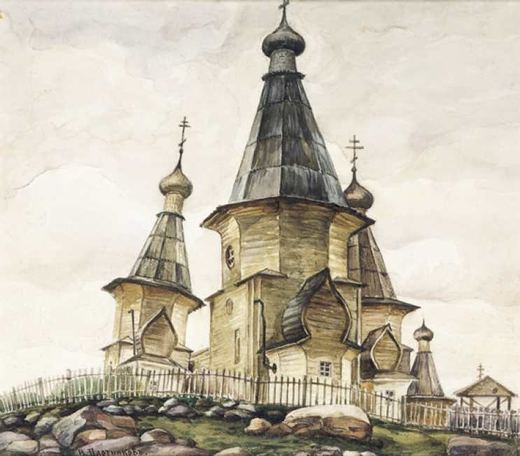
Church of the Dormition in Kem'
Wladimir Plotnikow
Watercolor on paper · 33 x 28 cm
The entry for Wladimir Aleksandrowitsch Plotnikow is one of the more problematic, but potentially very interesting, positions in the collection. The source list gives the life dates 1873-1947 and marks the person as not clearly identifiable. These dates, however, also correspond in public reference sources to a known physical chemist of the same name, rather than to a painter. The art-historically relevant W. A. Plotnikov is more plausibly associated in artistic and museum-historical contexts with the dates 1866-1917. For a public catalogue, this difference must be recorded clearly and not silently normalised. If the collection work is indeed connected with the artist W. A. Plotnikov (1866-1917), the profile concerns a painter and cultural figure who engaged closely with old Russian architecture, icons, church interiors and ethnographic collection contexts.
Such a position does not belong primarily to the spectacular line of salon painting or avant-garde innovation, but to the field of historical reconstruction, monument awareness and the preservation of Russian antiquities. This is precisely what makes the entry valuable for a high-quality collection: it links art history with cultural heritage, ethnography and sacred visual tradition. In the late nineteenth century, engagement with old Russia, church architecture, folk art and national formal traditions became an important cultural concern. Artists such as Plotnikov can be understood in this context as mediators between academic painting, historical research and visual documentation. Their subjects were not only aesthetic motifs, but also carriers of identity: iconostases, old churches, rural building forms, Russian ornament and regional traditions.
For I tesori della Russia, Plotnikov is therefore not published prematurely as a fully secured artist with the dates 1873-1947. The correct approach is a source-critical profile that explains the possible art-historical relevance while also recording the need for attribution work. If the object can be securely connected with the painter and researcher of Russian antiquities, it would add an important layer to the collection: the preservation and artistic transformation of old Russian cultural memory.
If the attribution to the artist Plotnikov (1866-1917) is confirmed, the emphasis is not on modern formal revolution, but on pictorial engagement with old Russian culture, monument preservation, icon and architectural traditions. Such work is culturally and historically valuable because it connects collecting, research and visual representation.
The source list identifies Plotnikov as not clearly attributable. For I tesori della Russia, the entry is kept as a review position until the object-level evidence is secured. Its potential collection value lies in the connection between Russian painting, sacred culture and ethnographic memory.