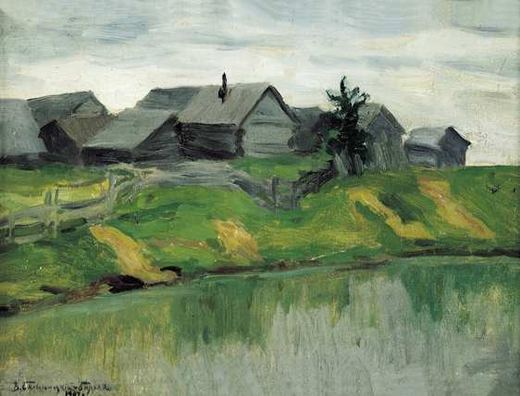
Houses on the Pond Shore
Witold Bialynitsky-Birulya; Vitold Kaetanovich Bialynitsky-Birulya
1907 · Oil on canvas · 38 x 29 cm
Witold Kaetanowitsch Bjaluinitskij-Birulja belongs to the important landscape painters of the Belarusian-Russian cultural sphere in the first half of the twentieth century. His work stands in a direct line with the great Russian landscape tradition of the late nineteenth century, especially with the Moscow school and with the lyrical understanding of nature associated with Isaac Levitan. Bjaluinitskij-Birulja was not an artist of loud gesture or theatrical natural drama. His strength lies in a quiet, exact and poetic perception of landscape: thawing water, spring, village paths, meadows, riverbanks, lingering snow and the restrained transitions of the seasons. Born in the Mogilev Governorate, he first trained at Nikolai Murashko's Drawing School in Kyiv and later at the Moscow School of Painting, Sculpture and Architecture.
His career therefore connects a Belarusian place of origin with one of the central training institutions of Russian art. The Moscow landscape school gave him not only technical discipline, but also a concept of landscape as an emotional and inwardly charged space. In 1904 he became a member of the Peredvizhniki; in 1908 he was elected Academician of Painting. Later state honours in both the RSFSR and the Byelorussian SSR show that his work was recognised beyond a single regional frame. His painting is shaped by a concentrated range of motifs that gains depth precisely through repetition. Bjaluinitskij-Birulja is less interested in panoramic grandeur than in the finest shifts of tone, light and moisture. In his best landscapes, nature is not a backdrop but a living, breathing counterpart. This makes him a successor to the Russian mood landscape without reducing his art to mere epigonism.
The quiet, almost contemplative concentration on land, watercourses, sky and simple paths gives his paintings a particular credibility. For I tesori della Russia, Bjaluinitskij-Birulja is an important mediator between Russian and Belarusian art history. He broadens the collection through a landscape sensibility that is not primarily imperial or metropolitan, but rooted in precise observation of the rural world. In a collection that seeks to show Russian art in its historical breadth, this position is essential: it demonstrates how strongly Russian landscape painting was also sustained by borderlands, transitional regions and culturally multilingual spaces of the former empire.
Bjaluinitskij-Birulja's work is built on tone, moisture, light and seasonal atmosphere. Quiet compositions with rivers, remaining snow, village roads and spring landscapes are characteristic. The pictorial language is lyrical and restrained, yet not decorative; it concentrates on the experience of landscape as an emotionally charged space. His importance lies in carrying forward the Levitanian mood landscape in a Belarusian-Russian context.
The source list names numerous museums in Kostroma, Nizhny Novgorod, Krasnoyarsk, Voronezh, Tomsk, Tver, Chelyabinsk, Stavropol, Semey, Sochi, Odessa, Omsk, Dnipro/Dnipropetrovsk, Kyiv, Minsk, Mogilev and Bialynichy. For I tesori della Russia, this makes him a geographically and art-historically expansive figure: away from the centre alone and toward a polyphonic landscape culture of the Russian-Belarusian sphere.