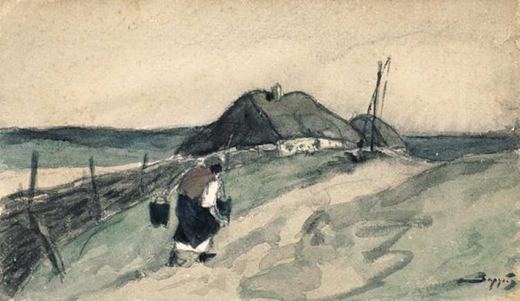
Peasant Woman Carrying Water
Viktor Ivanovich Zarubin
Watercolor on paper · 18 x 10 cm
Viktor Ivanovich Zarubin is an artist of transitions: born in Kharkiv, initially trained outside the narrower art world, shaped by Paris and Saint Petersburg, and active as painter, graphic artist and stage artist. His work connects the Ukrainian-Russian cultural landscape of the late imperial period with academic training, French studio practice and the painterly culture of light associated with the circle around Arkhip Kuindzhi. Zarubin was born in Kharkiv and first completed studies in physics and mathematics at the University of Kharkiv. This biographical particularity sets him apart from many contemporary artists. Only afterwards did he turn decisively to art. In 1893 he went to Paris, where he studied at the Academie Julian with Jules Lefebvre and Tony Robert-Fleury.
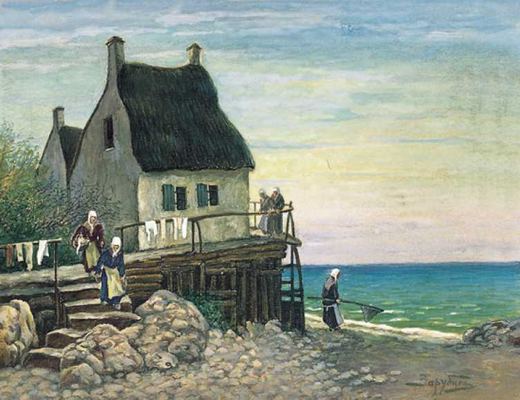
This Parisian phase is important for his international orientation: there he encountered academic figure painting, salon presentation and a Western understanding of professional artistic career-making. After returning to the Russian Empire, he studied at the Imperial Academy of Arts in Saint Petersburg, including in the orbit of Arkhip Kuindzhi. Kuindzhi's impact is visible less as direct imitation than as a particular sensitivity to light, atmosphere and large-scale moods of nature. Zarubin's preferred genre became landscape with figures. His nature is often inhabited: by pilgrims, fisherwomen, rural groups or quiet human presence. Unlike Shishkin, the botanical objectivity of nature does not stand at the centre; rather, Zarubin is concerned with the connection between landscape, mood and the human figure.
Zarubin was awarded the rank of Artist of the First Degree in 1898 and named an Academician in 1909. After the Revolution he also worked on festive decorations, exhibitions and book illustrations, and in the 1920s became associated with the Soviet artists' organisation AKhRR. This late phase shows his adaptability within a radically changing art system. He did not belong to the Avant-Garde, but neither does he simply belong to a closed nineteenth century. His work mediates between late academic landscape, symbolically charged nature and the demands of the early Soviet art public. For viewers today, Zarubin is especially interesting because his art crosses national categories. Kharkiv, Paris and Saint Petersburg form a biographical axis that makes visible the complexity of the Eastern European art field around 1900.
His works may therefore be read both in the context of Ukrainian art history and within Russian academic and exhibition culture.
Zarubin's oeuvre is shaped by landscapes with figural staffage. The figures are rarely merely decorative; they give the landscapes a narrative, at times spiritual or social resonance. Colour and light create moods between calm, melancholy and solemn distance. His training at the Academie Julian and at the Petersburg Academy led to secure handling of the figure and a professional sense of composition. At the same time, he retained a preference for poetic, atmospherically dense scenes. As a stage artist and designer, he also brought an understanding of scenic space into his pictorial world.
For I tesori della Russia, Zarubin expands the collection context through an artist who embodies the cultural permeability between Kharkiv, Paris and Saint Petersburg. His profile makes it possible to present Russian art not as an isolated national phenomenon, but as a transregional space. Through Zarubin, the collection can exemplarily show the connection between academic training, European experience and Eastern European landscape and figure painting.