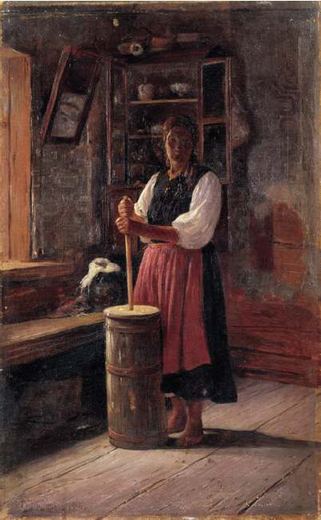
Preparing Butter
Viktor Andreevich Simov
1884 · Oil on canvas · 33 x 53 cm
Wiktor Andrejewitsch Simow belongs to those artists whose significance lies less in a conventional gallery oeuvre than in the fundamental renewal of Russian theatre. He was a painter, graphic artist and, above all, a stage designer. His name is closely connected with the Moscow Art Theatre and with the theatre reform associated with Konstantin Stanislavski. In this context, stage design was no longer understood as decorative backdrop, but as a psychological space that carries action, atmosphere and the guidance of the actors. Simow trained at the Moscow School of Painting, Sculpture and Architecture. Early on he worked as an illustrator and decorative painter, including in the circle of Savva Mamontov's Private Opera. This milieu was especially important for Russian art because painting, music, stagecraft, handwork and the formation of a national style were closely connected there.
Simow emerged from this broad artistic culture and later translated it into a new, realistically condensed theatre aesthetic. His decisive influence unfolded from the late 1890s onward at the Moscow Art Theatre. For numerous productions he developed spaces that did not merely arrange what was visible, but expressed the inner state of a scene. He became known for his ability to bring milieu, light, everyday detail and dramatic tension into a single visual order. In this respect he belongs to the artists who led the transition from the painted scenic prospect to the modern stage environment. Simow is also relevant to film history. His work on the visual design of Yakov Protazanov's film Aelita links him with early Soviet film culture and with the visual construction of imaginary spaces.
For a collection of Russian art, this aspect is important: Simow shows that Russian modernity did not unfold only on canvas and paper, but equally on stage, in film and in the intermedial laboratories of the early twentieth century.
Simow's pictorial language is defined by observation, spatial credibility and atmospheric condensation. While the Russian avant-garde would later work with radical abstraction and constructive form, Simow developed a different kind of modernity: he renewed realism from within. Rooms, furniture, walls, windows, light sources and material surfaces become carriers of psychological information. Art-historically, he stands at the intersection of painting, theatre art and directing; his work is a key to understanding how Russian visual culture entered space, movement and performance.
The source list for I tesori della Russia associates Simow with museum contexts including the Tretyakov Gallery, the Russian Museum, Paris museums, the Metropolitan Museum, Tate and the Centre Pompidou. These attributions is checked carefully for catalogue use, because the standard external biography documents Simow chiefly as a theatre and scenographic artist with the dates 1858-1935. For the collection, he nevertheless remains a significant bridging figure: he expands the concept of Russian art from easel painting to the design of stage, space and modern visual experience.