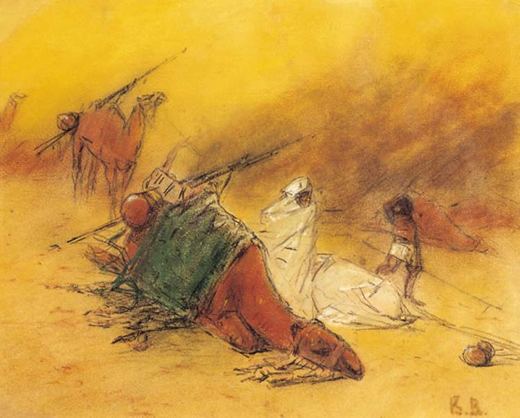
Soldiers and Camels Resting
Vasily Vasilyevich Vereshchagin
Pastel on paper · 29 x 23 cm
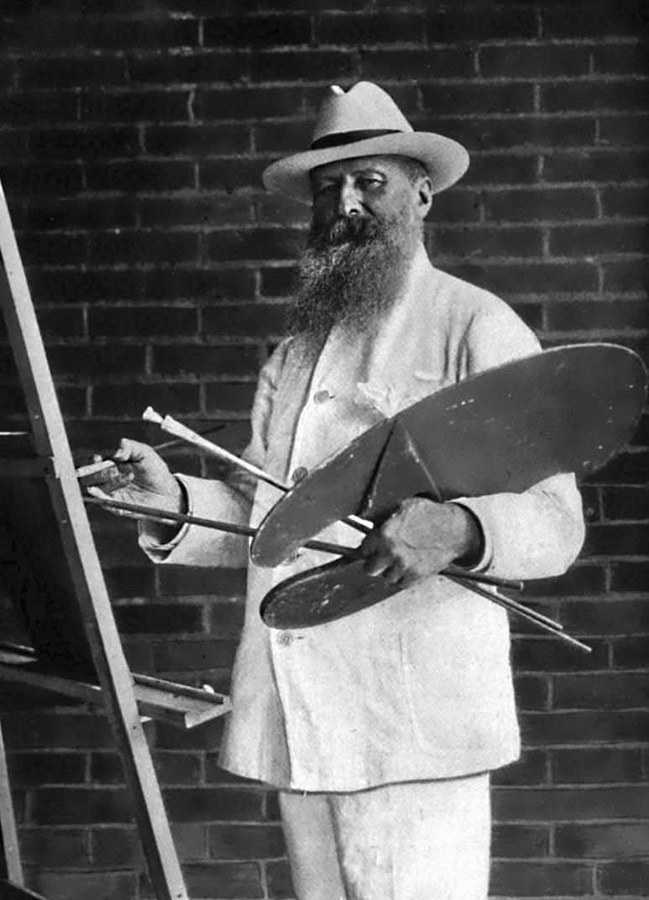
Vasily Vasilyevich Vereshchagin is among the internationally best-known Russian painters of the nineteenth century and is regarded as one of the most important war artists in European modernity before the twentieth century. Unlike many battle painters, he did not glorify war. He showed its violence, exhaustion, absurdity and moral devastation. This critical stance made his work famous, but also controversial: the unsparing depiction of military reality contradicted the heroic representational image that states and armies preferred to project of war. Vereshchagin was born in 1842 in Cherepovets and was initially trained for a military career. He attended cadet institutions and entered the navy, but soon turned decisively toward art. After studies at the Imperial Academy of Arts, his artistic development took him to Paris, where he studied under Jean-Leon Gerome.
At the same time, he did not simply remain bound to academic and Orientalist conventions, but developed an independent realist pictorial language out of his own travel experience and direct observation of war. His journeys to Central Asia, India, the Balkans and other regions made him one of the great travelling artists of the Russian Empire. The famous Turkestan series, the Indian pictures and the works connected with the Russo-Turkish War show not only exotic locations, but also the imperial, military and cultural tensions of the nineteenth century. Works such as The Apotheosis of War became icons of an art that allows the viewer no heroic distance, but confronts them directly with the consequences of violence.
Vereshchagin's death in 1904 in the explosion of the Russian battleship Petropavlovsk off Port Arthur tragically connects his biography with the theme that occupied his work throughout his life. He did not die as a detached history painter, but in immediate proximity to military events. This completes a life in which art, travel, war, witness and critique are inseparably linked.
Vereshchagin's work is marked by documentary intensity, large-scale impact and moral sharpening. His compositions use the means of academic painting - spatial depth, figure direction, precise materiality - but turn them against the traditional heroisation of war. Dead bodies, exhausted prisoners, devastated landscapes and silent monuments become indictments of violence and imperial glory. At the same time, his travel pictures possess an ethnographic and topographical precision that makes him especially significant for the history of imperial image production. Art-historical classification: Art-historically, Vereshchagin occupies a commanding position between Russian Realism, battle painting, travel art and Orientalism. His work belongs not only to Russian art history, but also to the broader European history of anti-war imagery, imperial representation and the visual culture of travel. He is a museum-level artist whose oeuvre can be interpreted through several major groups: the Turkestan series, India, the Balkans and the Russo-Turkish War, religious-historical works and later East Asian or Port Arthur contexts.
For I tesori della Russia, Vereshchagin is a top-level position. He opens the collection toward international museum presence, Russian Realism, military history, Orientalism and anti-war imagery. His works are represented in major international collections; the source list names, among others, the Tretyakov Gallery, the Russian Museum, the Brooklyn Museum, the Metropolitan Museum, the Art Institute of Chicago, Harvard Art Museums and Tate. In a high-quality collection narrative, Vereshchagin stands for the ability of Russian art not merely to depict historical power, but to question it morally.