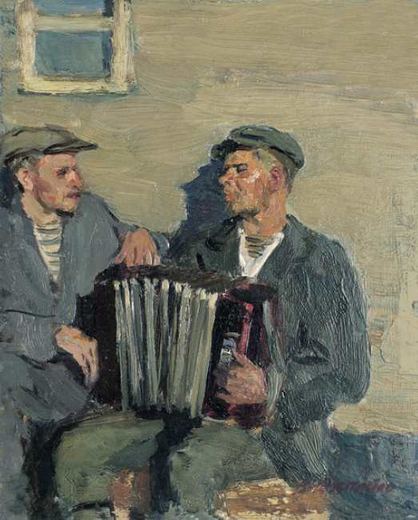
After the Work Shift
Vasily Kirillovich Nechitailo
1958 · Oil on cardboard · 20 x 24 cm
Vasily Kirillovich Nechitailo is one of the notable representatives of Soviet painting in the middle and second half of the twentieth century. His work is closely connected with the major subjects of Socialist Realism: collective labour, rural community, the historical legitimation of Soviet order, portraiture and monumental genre painting. At the same time, Nechitailo is not read solely as a propagandistic artist. His importance also lies in a pronounced painterly talent, a sure sense of colour and the ability to organise large groups of figures within dynamic, often sun-filled pictorial spaces. Nechitailo was born in southern Russia. He received his first artistic training at the Krasnodar Art Technical School and then studied at the Moscow Art Institute, later the Surikov Institute. His teachers included Sergei Gerasimov, Igor Grabar, Nikolai Maximov and Mikhail Shemyakin.
This education united academic discipline with a Soviet idea of painting as a public medium. From 1939 onward, Nechitailo took part in exhibitions; in 1944 he became a member of the Moscow Artists' Union. The Kuban and the south of Russia remained decisive for him throughout his life. Many of his most important pictorial ideas arise from the connection between rural space, collective everyday life and the physical presence of people. Works such as Collective Farm Youth, Bread for the Motherland, Lyubochka the Postwoman and Waiting for the Bride and Groom show his interest in scenes of everyday life that are at the same time symbolically charged. Especially in the later Kuban pictures, a strong awareness of colour and light becomes tangible: midday sun, bright earth, warm faces and broad brushwork produce a painting that, despite its ideological framework, possesses its own visual energy.
Nechitailo was People's Artist of the RSFSR, a corresponding member of the Academy of Arts of the USSR and is represented in important museum collections. His career therefore unfolds at the centre of the official Soviet art system. For a present-day collection, precisely this position is interesting: it shows how art in the twentieth century functioned not only as autonomous expression, but also as state-sponsored, institutional and socially charged image production. A professional profile of Nechitailo must therefore do both: name the ideological function of his art and take its painterly quality seriously. His work represents a chapter of Russian-Soviet art that is often either dismissed or simplified in Western contexts.
A careful collection catalogue makes a more nuanced distinction: Nechitailo was a representative of the official system, but also a technically accomplished painter of figures, colour and southern landscape.
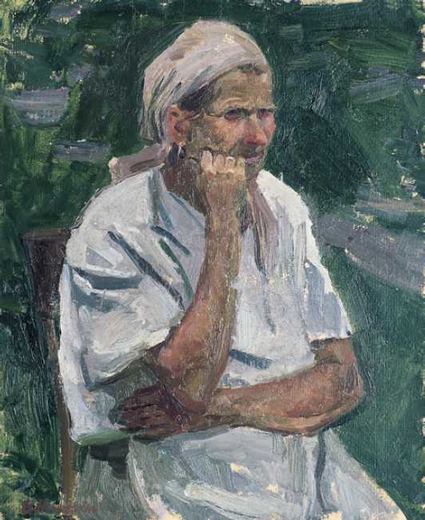
Nechitailo's painting is marked by powerful colour, broad handling of the brush and large-scale composition. He preferred scenes in which people appear in groups - at work, at festivals, in expectation or in historically charged moments. The focus is not psychological individualisation, but social types and a collective pictorial order. Alongside historical and ideological pictures, portraits and landscapes occupy an important place. His depictions of the Kuban in particular show that landscape was not merely a backdrop for him. It functions as an emotional and chromatic carrier of his pictorial world. Especially in later works, a painterly looseness emerges that visually exceeds the official subject matter.
For I tesori della Russia, Nechitailo is important because he brings the collection into the Soviet art of the twentieth century and into the institutional culture of Socialist Realism. Alongside the major names of the Avant-Garde and landscape painting, he shows how Russian art also operated as a state-supported, museum-anchored visual language. His inclusion allows Soviet painting to be presented in a differentiated way, beyond simple rejection or uncritical heroic framing.