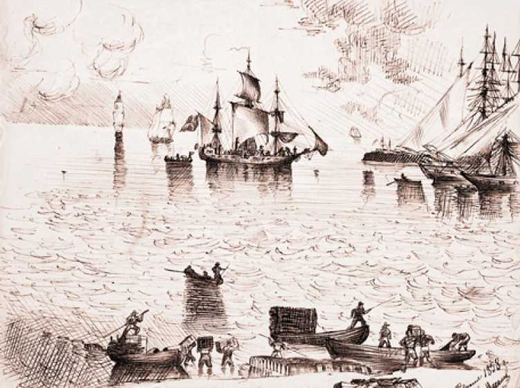
Port
Vladimir Maslov / V. Masalov
Ink on paper · 22 x 17 cm
Under the name Wladimir Maslow or V. Masalov, the collection lists an artist whose exact identification is checked again at object level before final public publication. The reference in the source list to the Moscow Museum of Tradition / Museum of Art of the 20th-21st Centuries most probably points to Vladimir Vladimirovich Maslov, a Russian artist of naive art who was born in 1934 in Lyapunovka in the Tula region and died in 2020 in the Tver region. Maslov's biography stands in strong contrast to the academic tradition represented by many artists in the collection. He did not emerge from an established artistic milieu, but from a rural teachers' family and grew up under the pressures of the Soviet war and post-war period.
The biographical stages transmitted in the sources - childhood in villages, flight from hunger, training in Moscow for railway work, brief contact with a drawing studio and subsequent independent artistic development - help explain the special tension of his work. It combines the directness of folk art with a strikingly conscious concentration of pictorial form. If the attribution is confirmed, Maslov occupies a rare position within I tesori della Russia. He extends the view of Russian art beyond academy, avant-garde and official socialism, showing a line in which the image emerges not from institution, school or courtly commission, but from individual memory, religious-folk imagination and a powerful inner world of images.
His painting therefore enters into a productive dialogue with the lubok, with Russian icon and folk-image traditions, and with the expressive formal freedom that was reassessed in the twentieth century by avant-garde and non-academic artists alike. In such a context, apparent simplicity is not mistaken for artistic weakness. The force of the image lies precisely in the direct pictorial order, in the vivid contour and in the capacity to turn remembered experience into a condensed symbolic world. For a public catalogue, the public presentation remain cautious until signature, reverse inscriptions, work image and provenance support the identification. The artist is presented as a probable Maslov attribution, but the wording must not convert a working hypothesis into a confirmed fact.
Maslov's pictorial language is marked by narrative fullness, strong contour, compressed symbolism and an immediate, at times almost visionary chromatic force. Perspective does not follow academic space, but the internal order of the image. Figures, houses, animals, landscape zones and ornamental structures are not subordinated naturalistically; they receive an equivalent life of their own. The result is a pictorial world that is less observed than remembered, less documented than imagined. Art-historically, Maslov - if the identification is confirmed - is not read as a marginal curiosity, but as a representative of an alternative Russian modernity. Russian naive art has its own significance because it makes forms of memory, popular religiosity and social experience visible outside academic hierarchies. In his work, Russia appears not as state-represented empire or avant-garde laboratory, but as a mental space of village, myth, catastrophe, faith, everyday life and survival.
The collection connection is especially strong if the work in I tesori della Russia can indeed be linked to Vladimir Vladimirovich Maslov. It would then represent the voice of Russian folk modernism and naive art within the collection. Until final confirmation, however, the public catalogue entry uses a cautious name form or remain held back from prominent publication.