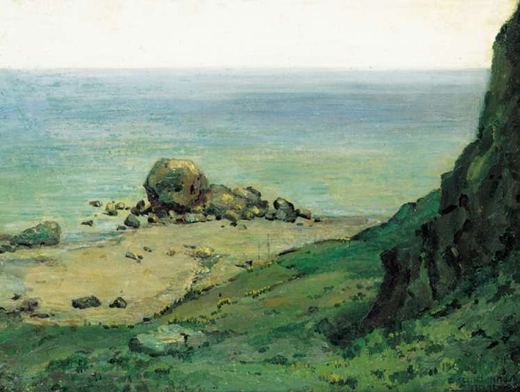
Black Sea
Stepan Ivanovich Slobodyanyuk-Podolianyn
1920 · Oil on canvas · 34 x 27 cm
Stepan Ivanovich Slobodniuk-Podoljanin is an important, though outside Ukraine and Russia little-known, figure of the regional art and museum landscape of the early twentieth century. He was a Ukrainian and Soviet painter, trained in the environment of the Odessa Art School and the Petersburg Academy, and he also played a role in the development of museum structures in Vinnytsia. His biography therefore links artistic production, educational history and regional cultural work. His career shows exemplarily how artists from the regions of the former Russian Empire moved between local origin, academic training and later Soviet institutionalisation. Slobodniuk-Podoljanin studied in Odessa and later attended the Imperial Academy of Arts in Saint Petersburg as a free auditor.
Such careers are essential for understanding Eastern European art around 1900: they show that the centres of Saint Petersburg and Moscow did not exist in isolation, but attracted and shaped artists from Podolia, Odessa, Kyiv, Kharkiv, Dnipro and other regions. Artistically, Slobodniuk-Podoljanin appeared above all as a portraitist. Portraits such as images of women, representations of workers, sailors or historical and regional types point to an interest in individual presence and social classification. His painting does not belong to the avant-garde radicalisation of the 1910s and 1920s, but rather to a Realist, figurative line that makes regional identity, social roles and historical memory visible.
For I tesori della Russia, this artist is particularly valuable if the collection wishes to represent not only the narrow Russian core, but the wider cultural space of the Russian Empire and the early Soviet Union. Slobodniuk-Podoljanin opens a view onto Ukrainian art history and onto the regional museum work that often disappears behind the great capital-city names. In a public catalogue, he is therefore not assimilated as a purely Russian artist, but identified precisely as a Ukrainian-Soviet artist within imperial and Soviet contexts.
His art is figurative, portrait-oriented and rooted in a Realist education. The focus is on people, regional types and social roles. Equally important is his museum activity: he was connected with the establishment and management of regional collections and thus also stands for the institutionalisation of art in Ukraine.
The source list names Ukrainian museum collections, the Dnipro / Dnipropetrovsk Art Museum and the Vinnytsia Regional Museum. For I tesori della Russia, the entry is understood as an expansion of the collection horizon toward Ukraine and regional Soviet art history.