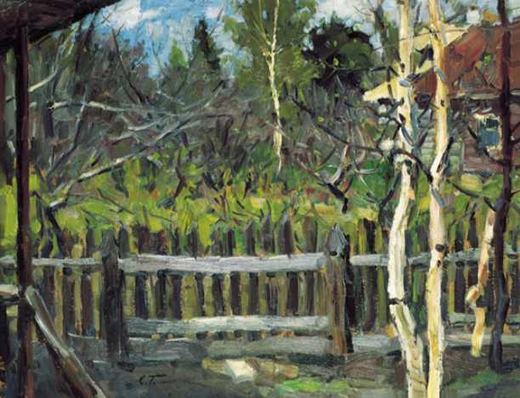
Dacha in the Forest
Sergei Vasilyevich Gerasimov
Oil on cardboard · 40 x 31 cm
Sergei Wasiljewitsch Gerasimow is one of the important artists of twentieth-century Soviet painting and also one of the figures who bridges the pre-revolutionary Moscow painting school and the institutional art of the Soviet Union. He was a painter, graphic artist, teacher, author of art-theoretical texts and an influential figure in Moscow artistic life. His oeuvre includes landscapes, portraits, genre scenes, historical and revolutionary compositions, yet his strongest works are marked by a humane, restrained and often lyrical sensibility. Gerasimow first studied at the Stroganov School and then at the Moscow School of Painting, Sculpture and Architecture with artists such as Konstantin Korovin, Sergei Ivanov, Abram Arkhipov and other representatives of a vivid, painterly tradition.
This training shaped his ability to use colour, light and atmosphere not merely as illustration, but as emotional substance. Even when Gerasimow later treated official themes, many works retain a painterly culture that exceeds programmatic content. His best-known work in Soviet memory is the 1943 composition A Partisan's Mother. It presents war not as decorative triumph, but as a moral trial. An older woman stands before a force of violence; the inner steadfastness of the figure becomes the true centre of the painting. This work makes clear that Gerasimow's realism is not read only as illustration or propaganda. In his best pictures the subjects are dignity, suffering, resistance, social responsibility and the psychological weight of historical events.
For I tesori della Russia, Gerasimow is important because he broadens the collection with a mature Soviet position that cannot be reduced to ideological surface. He shows how the Russian painterly traditions of landscape, figure painting and human observation were continued, transformed and politically charged in the Soviet period. In a serious collection, Gerasimow can stand for the fact that Soviet Realism was not only state art, but also a complex painterly language of memory, loss and moral attitude.
Gerasimow's art combines the solid Moscow painting school, lyrical landscape tradition and historical-figurative narration. His colour is often muted and atmospheric; his figure paintings seek psychological weight rather than external rhetoric. Especially in wartime and post-war works, a humanism emerges that connects the formal language of Soviet Realism with personal painterly experience.
The source list names the Tretyakov Gallery, the Russian Museum, the Institute of Russian Realist Art, the Krasnoyarsk Surikov Museum and the Taganrog Art Museum. For I tesori della Russia, Gerasimow is a central component of the Soviet section: he connects academy, Moscow School, war memory, state art and personal painterly culture.