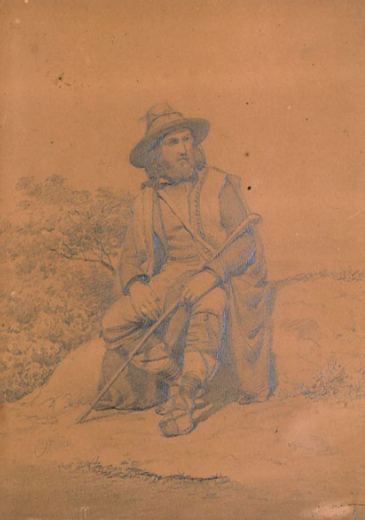
Shepherd
Rudolf Rudolfovich Frentz
Pencil on paper · 21 x 29 cm
Rudolf Rudolfovich Frentz is a central figure in Russian and Soviet battle painting of the twentieth century. He was born in 1888 in Marienburg in the Saint Petersburg governorate region and came from an artistic family: his father, Rudolf Ferdinandovich Frentz, was a known animal painter. This background shaped the artist's early sensitivity to horses, movement, military scenes and the connection between figure, animal and landscape. Frentz studied at the Imperial Academy of Arts and, from 1912, worked in the battle-painting studio of Nikolai Samokish, one of the major teachers of military and historical composition. This training anchored him in a tradition that required not only technical precision, but also the ability to organise dynamic mass scenes, cavalry movement and moments of narrative tension convincingly.
After the Revolution, Frentz remained active both artistically and pedagogically. He became a member of several artists' associations and helped shape the grad art scene as a teacher. His decades of work at VKhUTEIN and later at the Repin Institute made him an important mediator between the Imperial Academy tradition and Soviet art education. From the 1930s onward he headed the battle-painting studio and became a professor. Frentz therefore represents a line of Russian art that is often less prominent in avant-garde narratives, but was highly significant for the official, military-historical and academic visual memory of the Soviet Union.
Frentz's work combines precise observation of animals and movement with academic control of composition. Horses, riders, military formations and historical scenes are not merely iconographic motifs, but structuring forces within his painting. In contrast to purely propagandistic battle painting, Frentz's work retains the craft tradition of the nineteenth century: drawing, anatomy, rhythm and pictorial dramaturgy form its foundation. Art-historical classification: Art-historically, Frentz belongs to the battle-painting and animal-painting line that survived the transition from late Imperial academic culture into Soviet institutional art. His importance lies not in formal radicalism, but in the transmission of a demanding academic discipline: the organisation of movement, equestrian anatomy, military narrative and historical staging within a controlled pictorial structure.
For I tesori della Russia, Frentz is an important representative of the military-historical and academic line of Russian-Soviet art. He adds the aspects of battle painting, equestrian representation and grad training tradition to the collection. At the same time, his profile corrects an important data issue: the source list's date 1988-1956 is evidently a typographical error; the documented and usable form is 1888-1956.