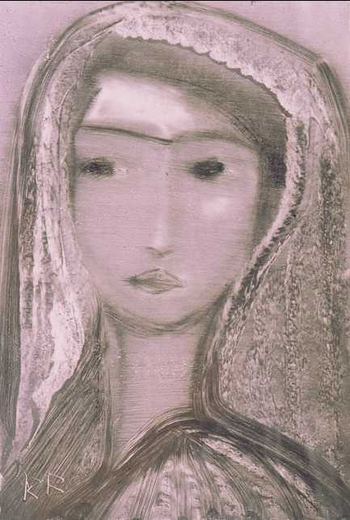
Portrait of a Woman
Rostislav Nikolaevich Barto
1968 · Monotype on paper · 23 x 33 cm
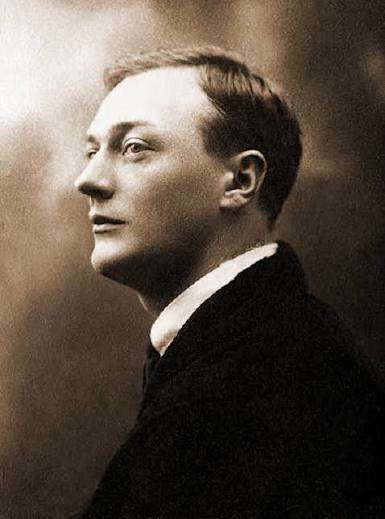
Rostislav Nikolaevich Barto belongs to the generation of Soviet artists whose work stands between the artistic energy of the 1920s, the ideological narrowing of the 1930s and a later, often quieter form of individual image-making. He was a painter, graphic artist and an outstanding practitioner of monotype. His art cannot be reduced to the official formulas of Socialist Realism; rather, it preserves a lyrical, experimental and deeply personal attitude toward nature, the figure and the picture plane. Barto was born in Moscow and entered VKhUTEMAS in 1922, the most important training institution of the Russian Avant-Garde and early Soviet modernism. He first studied in the graphic department with major teachers such as Vladimir Favorsky, Ignaty Nivinsky and Pyotr Pavlinov, before moving into painting with Alexander Shevchenko. This training was decisive for his work.
From graphic art he took a sensitivity to surface, line and imprint; from Shevchenko an openness to French art, painterly improvisation and the search for pictorial condensation. In the late 1920s Barto was associated with artistic groups such as the Guild of Painters and Bytie. His early works reveal the tensions of a time in which experimental modernism and new Soviet cultural policy still coexisted. In the 1930s his work at times came under suspicion of formalism. This experience helps explain why, despite museum significance and international exhibition activity, Barto long remained outside the centre of the official canon. His actual artistic profile developed through landscape, monotype, tempera and graphic series.
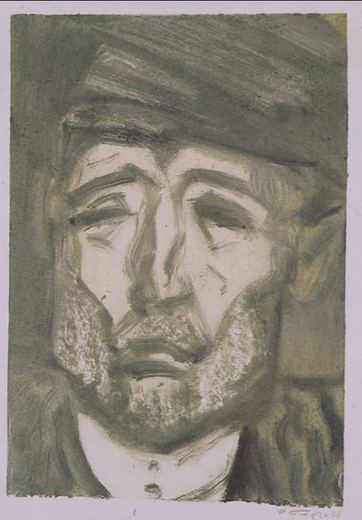
Barto was interested in the "second life" of things: in the inner pictorial energy of landscapes, female figures, animals, Caucasus and Crimea motifs, but also in grotesque portrait cycles. Monotype became an ideal medium for him because it joins control and chance, imprint and painting, speed and uniqueness. Through it, Barto could bring immediate perception and poetic estrangement together. His oeuvre occupies an important intermediate position within Russian-Soviet art history. It belongs neither wholly to the revolutionary Avant-Garde nor to the official representational realism of the Stalin period. Rather, Barto stands for a quiet, idiosyncratic modernism that continued to live in Moscow for decades - in studios, graphic techniques, private collections and later rediscoveries.
Barto's visual language is shaped by experiment and condensation. In monotype especially, he uses the medium's own logic: surfaces break open, lines emerge from impression and trace, forms appear like memories of nature or the figure. His landscapes are often less topographical than atmospheric. They transform seeing into a poetic structure. In addition to landscapes, he created images of women, animal representations, grotesque portraits and illustrations. The versatility of his work reveals an artist who did not subordinate himself to a single official task, but continuously searched for his own pictorial language. Precisely this gives his work its present relevance for a sophisticated collecting history of Soviet modernism.
For I tesori della Russia, Barto is especially interesting because he expands the collection into the field of less canonised, but art-historically important Soviet modernism. He stands for the afterlife of VKhUTEMAS culture, for the continuation of experimental graphic art and for those artists who worked between official cultural policy and personal pictorial research. His inclusion in the catalogue shows that the collection takes seriously not only the great names, but also the complex transitional zones of Russian art.