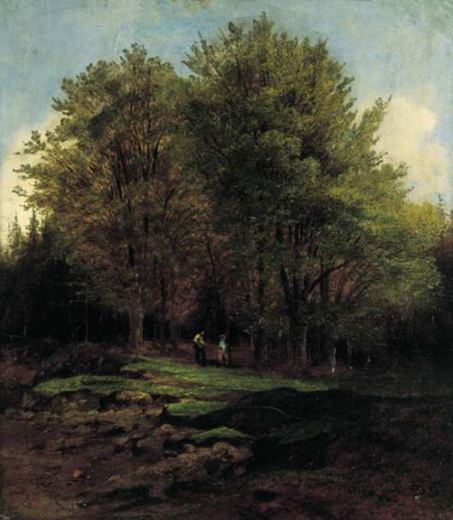
In the Clearing
Pyotr Nikolayevich Gruzinsky
Oil on panel · 40 x 46 cm
Pjotr Nikolajewitsch Gruzinskij belongs to the generation of nineteenth-century Russian artists who emerged from the academic school while also developing a growing interest in genre, everyday life, landscape and national-historical subjects. Born in Kursk, he studied at the Imperial Academy of Arts in Saint Petersburg, including under Bogdan Willewalde, one of the most important Russian battle painters of his time. Already during his training, Gruzinskij received academic distinctions. With the painting The Capture of Gunib he won the Academy's Great Gold Medal. This subject points to the Caucasus, which in nineteenth-century Russia was not only a military and political region but also a highly charged pictorial space between exoticism, empire, travel, landscape and war representation.
As a pensioner of the Academy, Gruzinskij spent several years in Western Europe, including Germany, Italy and France. This foreign study was part of the classical educational path of academic artists and broadened his repertoire. Nevertheless, his work remained clearly connected with Russian themes: soldiers, travellers, postilions, scenes of popular life, landscapes and military subjects form central fields of his painting. Gruzinskij is neither an avant-gardist nor a radical reformer. His significance lies instead in the solid connection of academic drawing, narrative subject matter and a Russian-imperial thematic horizon. He represents a layer of nineteenth-century art that was essential for the formation of Russian museum and exhibition culture: academically trained, historically interested and at the same time open to genre and everyday life.
Gruzinskij's pictorial language is based on clear composition, narrative legibility and careful handling of figures. In battle and Caucasus subjects, he combines academic order with topographical and ethnographic curiosity. In genre scenes, a stronger interest in everyday situations, travel, movement and social observation becomes visible. Art-historically, he stands between academic history painting and realist genre art.
The source list names the Tretyakov Gallery, the Russian Museum and museums in Voronezh, Saratov and the Kyiv context. For I tesori della Russia, Gruzinskij offers an important connection between the Academy, military painting, genre and regional museum transmission. His profile is particularly suited to conveying the broad basis of nineteenth-century Russian art to visitors.