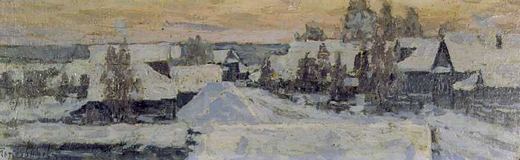
Winter Evening
Petr Ivanovich Petrovichev; Piotr Petrovichev
1916 · Oil on wood panel · 56 x 18 cm
Pjotr Ivanovich Petrovichev belongs to the important Russian landscape painters of the transition from the late nineteenth to the early twentieth century. His work stands in the aftermath of the great lyrical landscape school associated with Isaak Levitan, yet develops that tradition in a more personal, painterly and intimate direction. Petrovichev was not a painter of spectacular natural drama, but an artist of transitions: thaw, first snow, village roads, old churches, interiors and the quiet atmosphere of Russian places shape his oeuvre. His origins in the Yaroslavl region and his early training at the Rostov Museum of Church Antiquities are essential for understanding his work. There he not only learned drawing and painting, but also encountered restoration, icons, old Russian art and regional architecture.
Later he studied at the Moscow School of Painting, Sculpture and Architecture under artists such as Isaak Levitan and Valentin Serov. This combination of rural origin, old Russian cultural experience and Moscow painterly training explains the distinctive mood of his landscapes. Petrovichev’s painting has a material, living surface. Colour, light and atmosphere do not merely describe the motif; they carry its emotional quality. His landscapes often feel like spaces of memory: not sentimental, but marked by a quiet sensitivity to transience and the seasons. In the context of Russian Impressionism, he is therefore often understood as an artist who joined realist observation of nature with a freer, light-oriented painterly method.
For I tesori della Russia, Petrovichev is an important position because he enriches the collection through the lyrical landscape tradition of the early twentieth century. Between Levitan, Rylov and later Soviet landscape painting, he occupies a mediating role. His work can speak immediately to art-interested visitors because it makes the Russian landscape perceptible not as a political symbol, but as an emotional and cultural space.
His pictorial language is lyrical, painterly dense and concentrated on atmospheric transitions. Typical are softly modulated snow landscapes, village and church motifs, intimate interiors and a colour that does not merely describe light but carries emotional resonance. Petrovichev is an important representative of the Russian lyrical landscape after Levitan.
The source list names the Tretyakov Gallery, the Russian Museum, the Museum of Russian Impressionism, the Chazen Museum of Art and the Art Museum of the Republic of Karelia. For I tesori della Russia, Petrovichev is a strong building block for the narrative of Russian landscape painting between Realism, Impressionism and Soviet continuity.