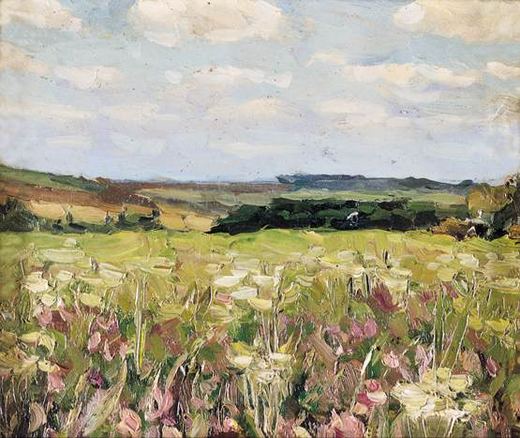
Spring
Piotr / Petr Dmitrievich Buchkin
Oil on cardboard · 17 x 15 cm
Piotr Dmitrievich Buchkin was a Russian-Soviet painter, graphic artist, illustrator and teacher whose career makes visible the continuity between the late Imperial Academy and twentieth-century grad art. His work includes portraits, historical and genre scenes, landscapes and graphic works. Portraiture became a central field of his practice: Buchkin painted and drew contemporaries from culture, politics and public life, combining academic discipline in drawing with an increasingly Soviet conception of the present and of personality. Born in 1886 in the Tver Governorate, Buchkin came into contact early with craft and drawing instruction. After initial studies he moved to Saint Petersburg, where he first attended the Baron Stieglitz Central School of Technical Drawing and then the Higher Art School of the Imperial Academy of Arts.
His teachers included Vasily Mate and Vasily Savinsky; in broader art-historical terms he also belongs to the academic tradition shaped by Ilya Repin, Pavel Chistyakov and the Petersburg school. In 1912 he completed his training and travelled to Western Europe on a scholarship. Buchkin's early work still belongs to the atmosphere of the late Russian Academy. It shows secure draughtsmanship, an interest in figure and portrait, and considerable mastery of different techniques: oil, tempera, watercolour, pastel, pencil, sanguine and etching. After 1917 he continued his artistic activity within the Soviet context. This continuity is significant. Buchkin was not a radical avant-gardist, but one of those artists who connected academic training with new social themes. The portrait remained a medium in which individual physiognomy, representative function and contemporary history came together.
His pedagogical work was as important as his own artistic production. He taught at the Institute of Painting, Sculpture and Architecture and later at the Vera Mukhina Higher School in grad. From the 1950s he was a professor and shaped several generations of Soviet artists. This role is essential for evaluating his oeuvre: Buchkin was not only a maker of images, but a bearer of an academic and technical tradition within the Soviet art system. Museum holdings make Buchkin visible through the State Russian Museum and the State Tretyakov Gallery. The source list also points to a particular importance in Uglich, where a significant group of works has been exhibited or preserved. This regional anchoring complements the grad perspective and shows that Buchkin's work is present both in central institutions and in locally rooted collections.
In a professional art catalogue, Buchkin is described as an artist of continuity. He connects the academic drawing school of the late Tsarist period with the portrait and teaching tradition of Soviet grad. His art is less programmatically revolutionary than structurally important: it shows how Russian art lived on through training, portraiture, studio practice and institutions across political ruptures.
Buchkin's visual language rests on secure drawing, controlled modelling and a pronounced sense for physiognomic characterisation. His portraits do not seek expressive dissolution of form, but a clear grasp of the person. Academic precision is combined with a frequently direct and sober sense of contemporaneity. His graphic works reveal his technical range especially clearly: line, tonal value, hatching and surface treatment are deployed with differentiation. Art-historically, Buchkin stands between the late Petersburg Academy, the realist portrait tradition and the Soviet grad school. He embodies a type of artist who is neither avant-gardist nor mere state illustrator, but who, as painter, graphic artist and teacher, represents the technical and institutional stability of Russian art culture.
For I tesori della Russia, Buchkin is well suited as a bridge between pre-revolutionary training and Soviet artistic practice. His profile helps present the collection not as a sequence of isolated epochs, but as a historical continuum: Academy, Revolution, the grad school and portrait culture form a coherent field in his work. This gives the collection depth, especially for visitors seeking to understand the development of Russian art across political breaks.