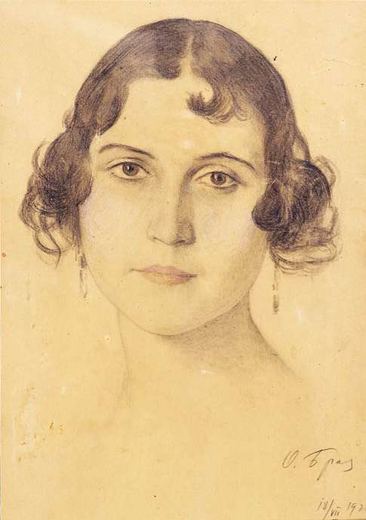
Portrait of a Young Woman
Osip Emmanuilovich Braz
1926 · Pastel on paper · 20 x 28 cm
Osip Emmanuilovich Braz is one of the most nuanced artistic personalities of the Russian Silver Age. He was a painter, graphic artist, portraitist, collector, museum professional and teacher. In his work, the realist portrait tradition of the late nineteenth century, Impressionist approaches to colour and light and the psychological culture of the Petersburg art scene around 1900 converge. He became especially known for his 1898 portrait of Anton Chekhov, now one of the canonical writer portraits of Russian culture. Braz was born in Odessa in 1873 and received an international and Russian education that connected him with both western European and Petersburg artistic currents. In Saint Petersburg he moved in an environment in which portraiture, literature, theatre, collecting and modern art were closely interwoven.
His portraits of writers, artists and cultural figures show not only external likeness, but also intellectual presence, restraint and psychological distance. He did not paint pathetic monuments, but concentrated images of a cultural elite. As a museum professional and collector, Braz also took part in the preservation and mediation of older art. This double role is decisive for his art-historical position: he was not only a producer, but also a connoisseur, preserver and mediator. After the revolutionary upheavals and his own experiences of persecution, he left Russia and spent his final years in France. His life story thus also becomes an example of the ruptures, exile movements and losses that shaped many artists of early twentieth-century Russian culture.
Braz's pictorial language is controlled, sensitive and psychologically concentrated. His portraits rest on secure drawing, restrained posture and tonal modulation that gives weight to the sitter's face and inner bearing. Landscapes and still lifes show his engagement with Impressionist problems of light and colour, yet usually remain disciplined and structurally clear. He is an artist of nuance, not of loud effect.
In I tesori della Russia, Braz occupies a key position between realist portrait tradition, the Silver Age and Russian exile culture. A work by Braz can connect the collection at the highest level with literary and intellectual Russia around 1900. His relationship to Chekhov, the Petersburg art scene and museum work makes him especially compelling for a demanding collection.