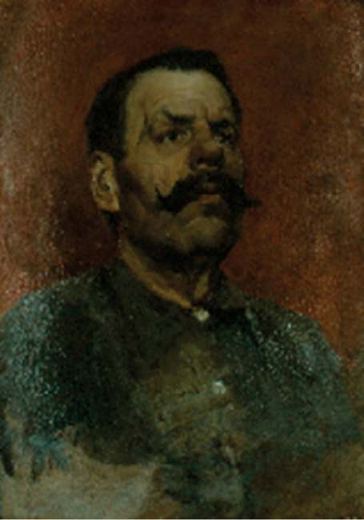
Portrait
Nikolai Pavlovich Khristolyubov
1948 · Oil on canvas · 43 x 58 cm
Nikolai Pawlowitsch Christolubow belongs to the generation of Soviet artists whose education and professional life were shaped by war, evacuation, reconstruction and state-organized art institutions. Born in 1918, he received his artistic training first within the environment of Soviet art schools and later at the Moscow State Surikov Art Institute. After the Second World War, this institute was one of the most important training centres for official Soviet painting. Christolubow worked as a painter, teacher and professor. Sources describe him as a member of the Artists' Union of the USSR, as an Honoured Artist of the RSFSR and later as a People's Artist of the Russian Federation. He was therefore firmly embedded in the official art system of late Soviet and post-Soviet Russia.
His career stands for a generation whose work was not defined by avant-garde radicalism, but by academically grounded, thematically legible and institutionally supported painting. His training in the orbit of artists such as Vasily Yefanov and Arkady Plastov, and in traditions close to Alexander Gerasimov, points to the Soviet demand for technical security, figurative clarity and ideologically acceptable subject matter. Christolubow's oeuvre includes narrative and thematic compositions, landscapes and scenes that belong to the visual culture of Soviet post-war painting. For a collection of Russian art, Christolubow is significant because he represents the official art production of the twentieth century. Contemporary collections often privilege avant-garde art and nonconformism; yet a picture of Russian art would remain incomplete without artists such as Christolubow.
He shows the continuity of academic painting within the Soviet system and the role of art as a pedagogical, social and institutional medium.
Christolubow's pictorial language belongs to the field of Soviet Realism. It is characterized by figurative clarity, thematic legibility, solid composition and the continuation of academic painting technique. The emphasis lies less on formal radicalism than on technical discipline, narrative intelligibility and the representation of people, work, landscape and social milieu. Art-historically, Christolubow can be read as a representative of official post-war painting, a field that long remained marginalized in art history but is increasingly relevant for a more complete understanding of Soviet art. His position adds to avant-garde, theatre art and nonconformism the broad institutional centre of Soviet visual culture.
The source list refers to state and regional collections of twentieth-century Russian art. Within I tesori della Russia, Christolubow represents academic-Soviet continuity. His profile helps visitors understand that Russian art of the twentieth century was not made only of avant-garde experiment and dissident counter-culture, but also of an official, technically ambitious and institutionally present painting. In the collection narrative, Christolubow has a balancing function: he connects the classical heritage of the academy with the Soviet image order after 1945 and therefore gives the collection historical breadth.