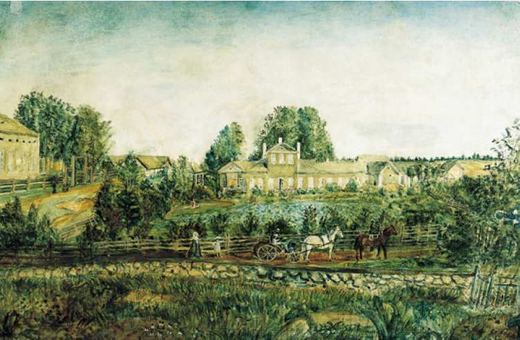
The Estate. Fantasy in the Manner of Soroka
Nikolai Nikolaevich Sapunov
1905 · Watercolor on paper · 45 x 30 cm
Nikolai Nikolajewitsch Sapunow is one of the most fascinating and at the same time most tragically brief figures in Russian art around 1900. His work stands at the intersection of Symbolism, theatre, decorative painting and the sensitive, nervous modernity associated with the Blue Rose and Mir Iskusstwa. Sapunow died in 1912 at the age of only thirty-two, drowning near Terioki, yet his compact oeuvre has an intensity that extends far beyond his short life. Sapunow studied at the Moscow School of Painting, Sculpture and Architecture with major teachers such as Isaac Levitan, Valentin Serov and Konstantin Korovin, and later at the Higher Art School of the Imperial Academy of Arts. In this way he joined the painterly sensibility of Moscow with a decorative and theatrical culture that became especially powerful on the stage.
He took part in exhibitions of Mir Iskusstwa, the Blue Rose and the Union of Russian Artists, and belonged to the generation that set colour, sound, dream and image into new aesthetic relationships. His pictorial world is often shaped by flowers, masks, stage spaces, still lifes, fantastic motifs and an almost musical sense of colour. In Sapunow's work, things do not appear as stable objects but as manifestations of an unstable, poetically charged world. His theatre work, including projects in Diaghilev's circle, shows his ability to translate painting not only onto canvas but into the space of performance. This connection between image, stage and mood is a central aspect of his art-historical importance. For I tesori della Russia, Sapunow is a high-quality position because he adds Russian Symbolism and theatre modernism to the collection.
He does not represent Realism, the Academy or official Soviet art, but rather the brief, dense period before 1914 in which Russian art joined colour, decoration, states of mind and theatre into a modern total experience. His profile can show sophisticated visitors that Russian art around 1900 was not only socially critical or avant-garde, but also dreamlike, theatrical, fragile and highly cultivated.
Sapunow's work is Symbolist, decorative and theatrical. Intense colour harmonies, floral still lifes, mask-like figures, theatre references and an atmosphere suspended between reality and dream are characteristic. His importance lies in the connection between painting and the stage and in the condensation of Russian Symbolist modernity before the First World War.
The source list names the Russian Museum, the Tretyakov Gallery, the Bakhrushin Theatre Museum in Moscow, Saratov, Nizhny Novgorod, Kazan and Russian private collections. For I tesori della Russia, Sapunow is a key to Symbolism, theatre art and the Blue Rose within the collection.