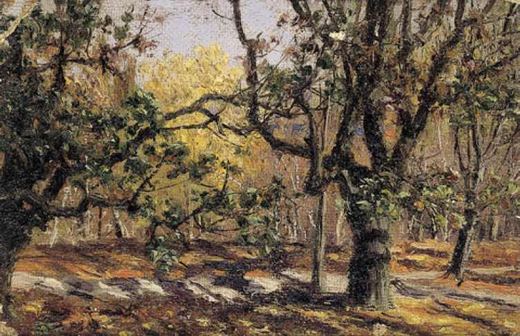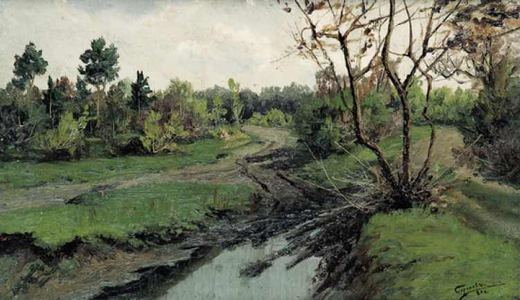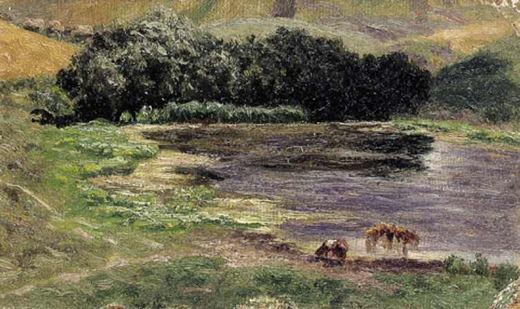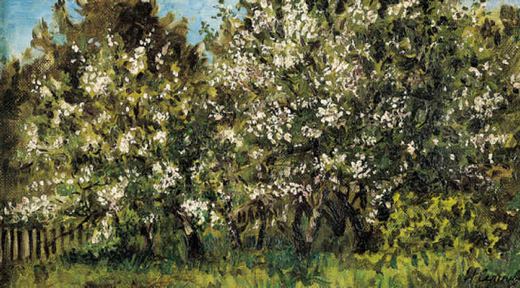
Spring. Apple Trees in Bloom in Ukraine
Nikolai Alexandrovich Sergeev / Sergeyev
Oil on canvas · 32 x 18 cm
Nikolai Alexandrovich Sergeev is a landscape painter of the late nineteenth century whose work represents a quieter, but art-historically revealing line within Russian painting. He does not stand at the centre of the revolutionary Avant-Garde, nor in the innermost circle of the most famous Peredvizhniki; yet precisely this gives him curatorial relevance. Sergeev makes visible how broad, differentiated and publicly effective Russian landscape art was around 1900. Sergeev was born in Kharkiv in 1855. His early artistic formation was connected with the southern Russian-Ukrainian region; he later moved to Saint Petersburg, where he received private instruction from Lev Lagorio and attended the Academy of Arts. Lagorio, as a landscape and marine painter, was an important mediator of an academically grounded understanding of nature.
From this training Sergeev took the ability to organise light, sky, water and breadth with painterly conviction. His work concentrates on landscapes often marked by an idyllic or lyrical character: villages, summer light, riverbanks, meadows, herds, still waters, rural labour and southern nature. He combines landscape with genre elements. Unlike purely topographical landscapes, his pictures often speak of a way of life: human beings, animals and nature appear in calm equilibrium. It was precisely this quality that made his painting attractive to collectors of the late nineteenth century. Sergeev participated in academic exhibitions, received a large encouragement silver medal in 1886, became an honorary free associate of the Academy in 1887 and was named an Academician of landscape painting in 1910.
He also took part in exhibitions of the Peredvizhniki and was a co-founder of the Saint Petersburg Society of Artists. These institutional stages show that Sergeev was by no means marginal in the art world of his time. He moved between the academic system, artists' associations and travelling exhibitions. Art-historically, Sergeev is especially interesting as a representative of a landscape ideal-realism. His paintings do not seek the sharp social critique of the early Wanderers, nor the symbolic concentration of Levitan, but a poetic order of nature, often carried by light. In his finest works a sense of calm, breadth and rural temporality emerges. The gaze is cultivated, not radical; sensitive, not dramatic.
For a collection of Russian art, this cultivated middle ground is significant precisely because it documents the taste, habits of looking and genre culture of the late Imperial period.
Sergeev's work is based on the effect of light, spatial breadth and narrative landscape mood. His compositions are usually clearly legible, harmoniously constructed and directed toward atmospheric effect. Figures and animals are not psychologically isolated, but embedded within the landscape. This connection between nature and rural motif links him to the Peredvizhniki, while also distinguishing him from their more strongly socially critical positions. His palette is often warm and sunlit; water surfaces, sky and grassy areas are the principal carriers of mood. Critically, his art is not dismissed as mere salon painting. It belongs instead to that layer of Russian landscape art that mediates between academic quality, collector taste and a national perception of nature.
For I tesori della Russia, Sergeev is important because he anchors the collection more broadly in the nineteenth century. He makes it possible to tell the story of Russian landscape not only through the most famous names, but through a differentiated field of academy, artists' societies, proximity to the Peredvizhniki and regional experience of nature. A profile on Sergeev place particular emphasis on atmosphere, light and collecting history. His presence signals to connoisseurs that the collection does not look only for iconic major works, but takes seriously the cultural-historical breadth of Russian art.