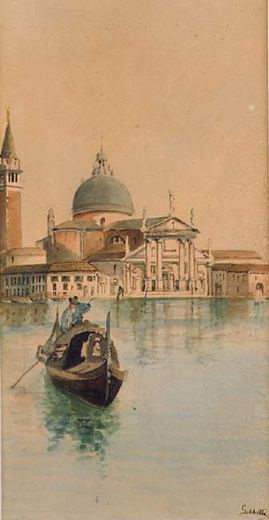
Gondolier
Nicola Dusi Gobbetti
Watercolor on paper · 15 x 29 cm
Nicola Dusi Gobbetti is a contemporary Italian artist, born in 1954, whose inclusion in a collection oriented toward Russian art must be carefully contextualised. The publicly accessible source base is limited and consists mainly of art-market records. These records refer to works from the 1970s, including abstract compositions, portraits and homages, usually in oil or mixed media. Gobbetti is therefore not a core artist of Russian art history. His profile is not artificially Russianised in the catalogue. A more professional approach is to classify him as a contemporary European supplementary or comparative position, whose specific relationship to I tesori della Russia must arise from provenance, acquisition history or the collection concept. Such an entry can be meaningful when a collection connects historical Russian art, Soviet art and international comparison points - but only with clear labelling. The few documented works suggest a practice between figurative and abstract painting. A Composizione Astratta from 1974 is recorded in an Italian auction context; other market references mention portraits and abstract works. These indications are sufficient for a cautious public basis text, but not for broad art-historical canonisation.
The documented works by Gobbetti show a range from portraiture to abstraction. For the catalogue, a precise object description is more useful than a broad stylistic thesis. If the collection work is abstract, the text develop its relationship to colour, composition, material and dating on the basis of the specific object. If it is figurative, the description focus more strongly on portraiture, pose, manner of painting and signature. The most important quality criterion here is not literary embellishment, but data integrity. A high-quality entry makes clear what is documented and what still requires review. Art-historical classification: Within the framework of this collection, Gobbetti is treated art-historically as a non-Russian, contemporary European position. Such peripheral positions can be valuable in a collection if they make acquisition history, dialogues between art regions or the development of the collector visible. They does not, however, be given the same art-historical status as museum-established Russian artists.
For I tesori della Russia, Gobbetti is handled as a verified special case. The collection relevance must be established through the specific work, provenance or curatorial logic. A restrained public formulation is recommended, together with internal prioritisation of provenance review.