Mstislav Valerianovich Dobuzhinsky
Mstislav Valerianovich Dobuzhinsky / Mstislavas Dobužinskis
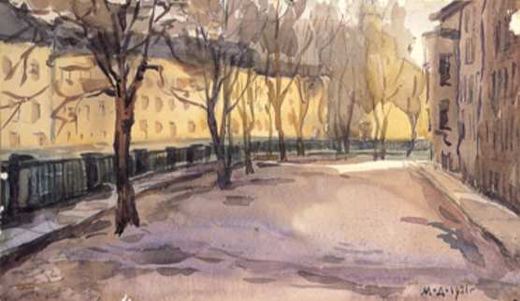
1921 · Watercolor on paper · 23 x 14 cm
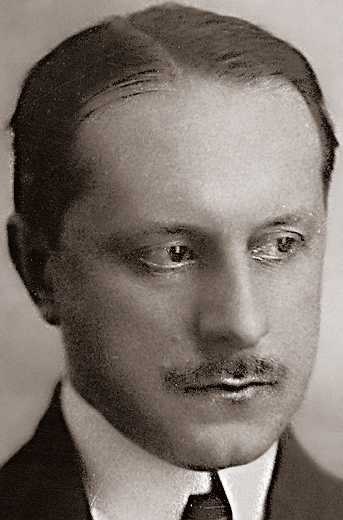
Mstislav Valerianovich Dobuzhinsky is one of the major artistic figures of the Russian Silver Age. As a graphic artist, painter, stage designer, illustrator, teacher and later emigrant, he connects several central lines of early twentieth-century art: the refined visual culture of Mir Iskusstva, the psychological cityscape, theatre modernism, book illustration and the transnational networks of Russian and Lithuanian art. Dobuzhinsky was born in 1875 in Novgorod into a family of Lithuanian-Polish origin. He first studied law at Saint Petersburg University while also pursuing artistic training. Around 1900 he continued his studies in Munich, including with Anton Azbe and Simon Hollosy, and came into contact with the Central European modern art environment.
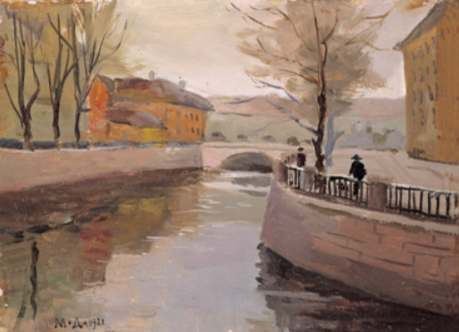
After returning to Russia, he became associated with Mir Iskusstva, the group around Sergei Diaghilev, Alexandre Benois and others that transformed Russian art through its cultivated historical awareness, graphic precision, theatre culture and decorative intelligence. The city became his central subject. Dobuzhinsky is one of the first artists to depict not only the monumental imperial facade of Saint Petersburg, but also courtyards, firewalls, narrow streets, modern urban unease and the psychological underside of the metropolis. His Petersburg is not merely a beautiful city; it is a mental space. Architecture becomes a bearer of mood, history, social tension and alienation. In this respect, Dobuzhinsky stands close to the modern literary image of the city, from Gogol to Dostoevsky and the Symbolists.
In addition to the cityscape, Dobuzhinsky was of outstanding importance for book and theatre art. He illustrated classics of Russian literature, worked for theatres in Petersburg and Moscow and designed sets for Russian and international stages. His stage designs reveal the same disciplined imagination as his graphic work: space is never just decoration, but atmosphere, interpretation and dramatic structure. After 1924 he lived mainly abroad, including in Lithuania, Paris, London and later the United States. His emigration made him a transnational figure in Russian art history. He carried the culture of the Silver Age beyond Russia and at the same time became an important part of Lithuanian and international theatre and design history. For a collection catalogue, this biography is not simplified. Dobuzhinsky is Russian, Lithuanian and European in equal art-historical measure.
Dobuzhinsky's artistic character rests on line, atmosphere and a special ability to read space psychologically. His city views are not simply topographical images. They show the city as a visual text: walls, windows, roofs, signs and empty streets become signs of memory, anxiety, irony or melancholy. His line is precise, but never cold; it carries both structural clarity and nervous sensitivity. In book and stage art, his mastery of narrative form becomes especially clear. He does not treat illustration as a later addition to a text, but as an intellectual interpretation of it. His stage designs transform literary and dramatic material into concentrated visual environments. This makes him a key figure in the media-crossing art of the Silver Age.
For I tesori della Russia, Dobuzhinsky is a key profile. He opens the collection toward the art of the Silver Age, Mir Iskusstva, theatre modernism and the urban psychology of Russian modernity. His presence lends the collection intellectual weight because he is a canonical artist and, at the same time, a subtle mediator between graphic art, literature, stage and exile. He is especially valuable for a catalogue that wants to present Russian art not only as painting, but as a complete culture of image, text, space and performance.