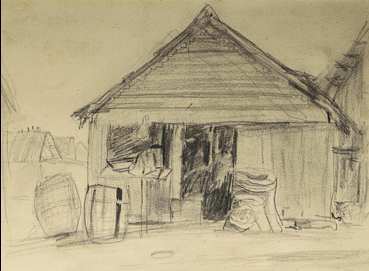
Native Village
Marc Chagall / Moishe Shagal
Pencil on paper · 20 x 15 cm
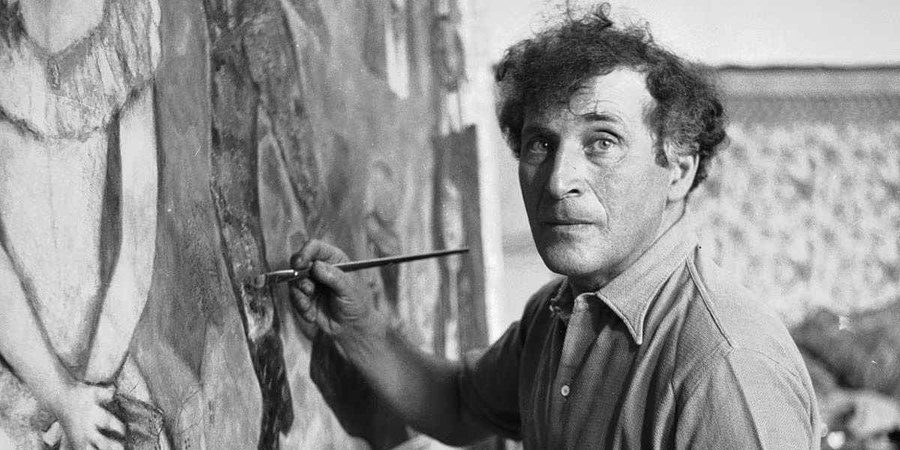
Marc Chagall is one of the most internationally significant artists of the twentieth century and at the same time a key figure for understanding Russian-Jewish modernism. Born in 1887 as Moishe Khatskelevich Shagal in Vitebsk, then part of the Russian Empire, he developed a pictorial world in which memory, dream, folk culture, Jewish symbolism, the Russian province, Paris and modern painting are inseparably joined. No other artist of his generation translated the image of the shtetl, the poetic force of remembrance and the freedom of modern form into such an unmistakable international language. Chagall's early years in Vitebsk shaped his entire oeuvre. Jewish life, religious festivals, musicians, animals, houses, lovers, craftsmen and family motifs recur throughout his later work, but never as mere illustration.
They are transformed into a floating, colour-intensive and dream-logical pictorial order. In 1907 Chagall went to Saint Petersburg, where he studied, among other places, at the school of the Society for the Encouragement of the Arts and at the Zvantseva School in the orbit of Léon Bakst. This encounter with Russian art education, theatre culture and decorative modernism was decisive before Paris opened his artistic language further. In Paris, where Chagall arrived in 1911, he encountered Cubism, Fauvism, Orphism and the international avant-garde. Yet he never became simply a Cubist or a Fauvist. Instead, he drew from the Parisian currents a new formal freedom, an intensified use of colour and expanded compositional possibilities, without surrendering his world of memory and symbol.
This is what makes Chagall's position unique: he belongs fully to modernism, yet he submits to no single “ism”. His figures fly, houses tilt, animals seem to speak in images, lovers hover above cities, and time is transformed into a poetic simultaneity. After the Revolution, Chagall returned to Vitebsk and became Commissar of Art for the Vitebsk Governorate. He founded an art school there where artists such as El Lissitzky and Kazimir Malevich soon worked. This moment is of enormous importance for Russian art history: in Vitebsk, Chagall's poetic modernism and Malevich's suprematist radicalism met directly. The resulting tensions eventually led to Chagall's departure, but they also show how central Vitebsk was to the Russian avant-garde after 1917. Chagall's later life led through Moscow, Berlin and Paris, into wartime emigration in the United States, and finally back to France.
His work expanded into printmaking, stage design, monumental painting, stained glass and sacred commissions. Despite his international career, Vitebsk remained his inner centre. In his finest works, memory is not nostalgic but creative: biographical origin becomes a universal pictorial language of love, exile, spirituality and vulnerable humanity. For I tesori della Russia, Chagall is indispensable because he places Russian art history within a transnational frame. He is neither only Russian, nor only French, nor only Jewish; his importance lies precisely in this multiple belonging. His work shows that Russian art did not emerge only from state centres and academies, but also from Jewish towns, cultures of remembrance, migration and the productive tension between East and West.
Chagall's pictorial language is poetic, colour-intensive and deliberately anti-naturalistic. Space does not follow central perspective, but the logic of memory, dream and inner vision. Figures may float, proportions may shift, and animals and human beings enter symbolic relations. Colour has emotional and spiritual force; blue, green, red and violet appear not only as optical values, but as carriers of mood and meaning. Art-historically, Chagall stands at the intersection of the Russian avant-garde, the École de Paris and Jewish modernism. He absorbed modern formal languages without dissolving his pictorial world into abstraction. Precisely for that reason he became one of the great counter-models to a purely formal understanding of modernism: in his art, history, memory, song and the religious dimension remain alive within the modern image.
For I tesori della Russia, Chagall has the highest international communicative value. He opens the collection toward European modernism, Jewish cultural history and the art of exile. His profile can show demanding visitors that Russian art history cannot be reduced to a narrow national narrative, but emerged from multilingual, religious and transnational milieus. Within the collection, Chagall is a key to the poetic and cosmopolitan side of Russian modernism.