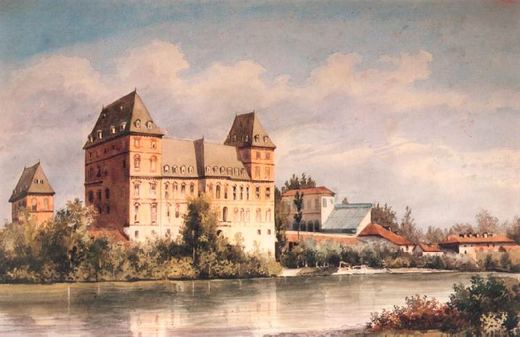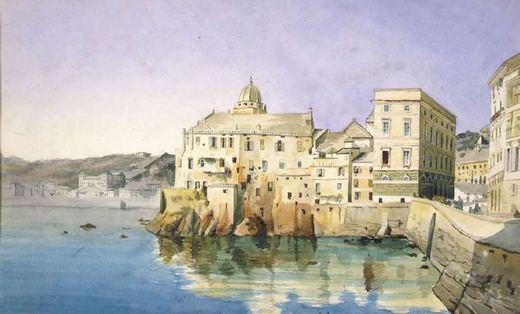
Coastal Landscape on the Black Sea
Luigi Premazzi / Ludwig Ossipovich Premazzi
Watercolor on paper · 35 x 22 cm
Luigi Premazzi, known in Russia as Ludwig Osipovich Premazzi, is a key figure of imperial Russian watercolour art in the nineteenth century. Born in Milan and trained at the Brera Academy, he brought the Italian tradition of perspective, architectural clarity and veduta painting into the Russian court context. His work is indispensable for understanding the visual culture of the imperial residences, because it combines architectural documentation, refined watercolour technique and courtly representation. Premazzi came to Russia in the 1830s and first established himself as a drawing teacher in aristocratic circles. His decisive rise began when his works attracted the attention of the imperial court. In 1850 he was appointed an academician; later he became a professor at the Imperial Academy of Arts in Saint Petersburg.
This career shows how successfully a foreign-trained artist could become integrated into the Russian imperial art system, while retaining the technical clarity of his Italian training. His fame rests above all on his interiors of the Winter Palace, the New Hermitage building, the residences at Peterhof and Tsarskoye Selo and other aristocratic spaces. Premazzi's watercolours are precise, luminous and at the same time richly atmospheric. They record furniture, architectural details, wall decorations, paintings, carpets, light sources and spatial relationships with remarkable discipline. Yet they are not merely documentary sheets. They transform rooms into images of power, taste, order and historical memory. For art history, Premazzi is especially interesting because he broadens the definition of Russian art.
He was Italian, yet lived and worked for decades in the Russian context and shaped the visual record of imperial Russian interiors. His work therefore belongs to a transnational court culture in which architecture, collecting, museum formation and artistic representation are inseparably linked. A serious collection of Russian art can use Premazzi to show that the Russian cultural field was never closed or monolithic, but formed through exchange, migration and service to institutions.
Premazzi's visual language is defined by strict perspective, linear precision and exceptional control of light values. His interiors are often composed from a clear viewpoint. Architecture, furniture and decorative elements are rendered with great accuracy, but the watercolour technique lends them transparency and elegance. Light is not incidental; it structures the room and guides the eye. In Russian art, Premazzi represents a genre situated between architectural drawing, court representation and independent artistic achievement. His works are essential sources for reconstructing interiors and museum spaces, but they are also highly accomplished pictorial objects. Their artistic value lies in the balance between documentation and aesthetic order.
For I tesori della Russia, Premazzi is an exceptionally valuable name because he expands the collection into the dimension of imperial spatial culture. While many Russian artists represent landscape, figure or avant-garde experimentation, Premazzi opens the world of palace interiors, architectural memory and courtly visual order. His presence allows the collection to tell the history of Russian art not only as a history of images, but also as a history of spaces, collections and institutions.