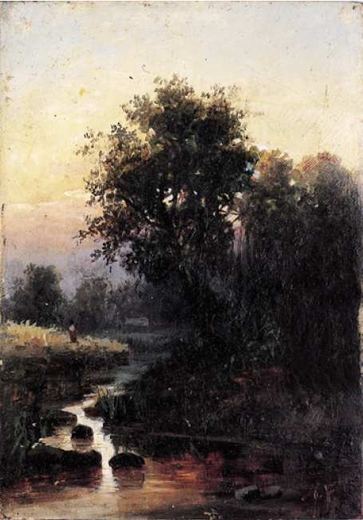
Stream
Longin Khristianovich Frikke / Login Frikke
1840 · Miniature, oil on wood panel · 10 x 14 cm
Longin Khristianovich Frikke, also written Login or Loggin Frikke, is a Russian nineteenth-century landscape painter whose work connects the academic landscape tradition with the pictorial exploration of regional spaces. He trained at the Imperial Academy of Arts, received major distinctions early in his career and spent several years in Italy. After his return to Russia, he was appointed an academician of landscape painting. His later activity in Crimea and the Don region made him an important figure in the artistic perception of the southern landscapes of the Russian Empire. Frikke entered the Academy as a young man and studied with Maxim Vorobiev, one of the major landscape and veduta painters of his time.
Vorobiev's teaching gave him a classical academic understanding of landscape: clear perspective, harmonious pictorial space, controlled handling of light and a union of natural observation with composed view. In 1839 Frikke received the Academy's large gold medal for a view in the surroundings of Dorpat. This distinction enabled him to travel abroad, particularly to Italy, where many Russian artists of the nineteenth century deepened their conception of light, architecture and landscape. After his return, Frikke was named an academician for the works he had produced abroad. His early career thus followed the classical model of the academically successful landscape painter. His art-historical distinctiveness, however, lies less in a metropolitan Petersburg career than in his later turn toward southern landscapes.
In Crimea and later in Novocherkassk he painted landscapes in which nature, topography and regional life come together. The Don region in particular is associated with his name; local sources describe him as a founder or early principal representative of Don landscape painting. Frikke's work is not revolutionary in the avant-garde sense, but it is important for Russian art history because it shows how academic landscape painting made regional spaces of the empire visible. The gaze is directed not only toward Italy, Petersburg or the central Russian landscape, but also toward Crimea, the Don, the steppe, estates and southern settlement areas. Frikke therefore belongs among those artists through whom the geographical image of the empire was artistically expanded.
His art is also a good example of the transitional position occupied by many Russian landscape painters of the nineteenth century. They stand between classical veduta, Romantic feeling for nature, academic order and increasingly realistic observation. For contemporary collection work, precisely this position is of interest because it makes visible the variety of landscape traditions before the rise of the Peredvizhniki and later modernism.
Frikke's visual language is academically ordered, perspectivally clear and directed toward harmonious landscape effect. In early works the school of Vorobiev is evident, especially in the combination of veduta precision and painterly atmosphere. His Italian experience strengthened his sense of light, architecture and composition. In later works devoted to Crimea and the Don, regional character becomes more prominent. Landscape is treated not only as ideal scenery, but as a space with its own topography, vegetation and cultural imprint. Frikke is therefore especially relevant where Russian landscape painting is understood as an instrument for geographical and cultural perception.
For I tesori della Russia, Frikke expands the concept of landscape toward the south of the Russian Empire. Alongside forests, central Russia and Petersburg, the Crimean and Don landscape enter the collection through him. His profile allows visitors to understand the academic landscape tradition and its role in the visual mapping of regional spaces.