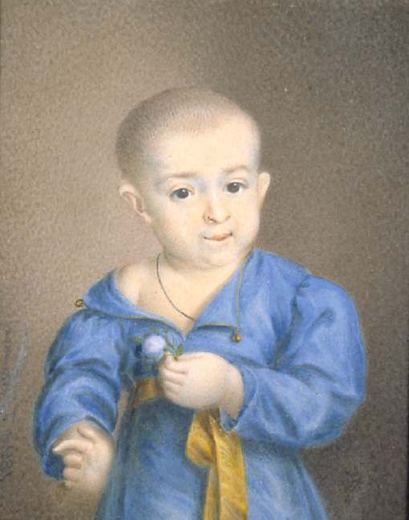
The Child
Lev Dmitrievich Kryukov
1829 · Watercolor on paper · 8 x 10 cm
Lew Dmitrievich Kryukov is an important, though outside Russia less widely known, figure in early Russian provincial painting. His work leads into a period in which artistic culture can no longer be located exclusively in Saint Petersburg and Moscow. Kryukov was a portraitist, miniaturist, teacher and religious painter in Kazan. As such, he represents the formation of a local artistic public sphere in which the university, civic society, scholarship and portraiture were closely connected. Kryukov was born in 1783, probably in the Simbirsk Governorate, and came from the social stratum of the serfs. He received his artistic training in Moscow, including in the circle of the Italian teacher Claude and in the household of the celebrated portraitist Dmitry Levitsky. This connection is significant: Levitsky embodied the high portrait culture of the late eighteenth century.
Kryukov transferred elements of that tradition into the provinces, where demand grew for portraits of professors, scholars, officials, merchants and local personalities. In 1806, through the mediation of Karl Fuchs, Kryukov obtained a position at Kazan University, where he taught students drawing and various painting techniques. A year later he was formally accepted into university service. In 1813 he accompanied Professors Erdmann and Fraehn on a journey to Bolgar as a draughtsman. These biographical stations show that his artistic activity was not limited to private portrait commissions. He formed part of a learned visual culture in which drawing served education, documentation, scientific expedition and social representation. As a portraitist, Kryukov was recognised in Kazan.
He created portraits of important representatives of local society, including Karl and Alexandra Fuchs, Ivan Protopopov, Maria Korinfskaya and miniature portraits of other Kazan figures. His works often follow a clear and restrained structure: half-length figures or bust portraits before a neutral background, frontal or slightly turned poses, direct gazes and carefully rendered clothing. This restraint gives the portraits dignity and legibility. Kryukov is particularly interesting because his work makes visible the social function of portraiture in the provinces. The portrait was not only a courtly form of self-representation; it also became part of a rising academic and civic culture. To be portrayed was to document education, rank, affiliation and personal presence. Kryukov's art is therefore an important building block for understanding Russian art beyond the capital centres.
Kryukov's visual language is calm, classicising and concentrated on the recognisability of the sitter. Characteristic features include neutral backgrounds, clear silhouettes, carefully modelled faces and controlled colour. His miniatures in particular required a high level of technical precision. They reveal the desire for personal proximity and social representation in a small, intimate format. Alongside portraiture, Kryukov also worked in religious painting and as a decorator and teacher. This versatility was typical of provincial artists. They had to serve different cultural needs rather than pursue only an individual artistic programme: teaching, church interiors, the university, private memory and public representation.
For I tesori della Russia, Kryukov is relevant because he adds an early, provincial and educational-historical dimension to the collection. He does not represent the great metropolitan centres, but the spread of artistic culture in Kazan and at the university. A profile on Kryukov shows sophisticated visitors that Russian art history is also made up of regional centres, social mobility and local portrait traditions.