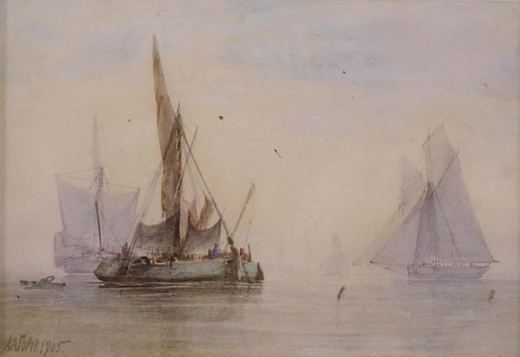
Sailing Ships
Lev Feliksovich Lagorio
1905 · Watercolor on paper · 34 x 24 cm
Lev Feliksovich Lagorio belongs to the important representatives of Russian marine and landscape painting of the nineteenth century. His name is closely connected with Crimea, with Feodosia and with that distinctive school of maritime imagery which, in the Russian cultural sphere, achieved international resonance above all through Ivan Aivazovsky. Lagorio, however, was not merely a follower of Aivazovsky. His painting combines academic training, topographical precision and a sensitive understanding of atmosphere into a distinct pictorial type: coasts, harbours, rock formations, mountain lines and calm or moving expanses of sea appear in his work as spaces of historical memory and landscape observation at the same time. Born in Feodosia into a family connected with the Italian consular and mercantile milieu, Lagorio encountered the coastal landscape of Crimea at an early age.
His encounter with Aivazovsky's work shaped his turn toward marine painting, while his training at the Imperial Academy of Arts in Saint Petersburg disciplined his artistic language. There he studied in an academic environment that linked close observation of nature with compositional order and representative effect. Travels to the Caucasus, Italy, France and later other parts of Europe broadened his range of motifs and made him an artist who understood the sea not as a decorative backdrop, but as a culturally and geographically complex space. His pictorial language is characterised by calm, lucid compositions, a finely graded handling of light and a particular sensitivity to the threshold between water, land and sky.
In contrast to more dramatic maritime battle or storm compositions, Lagorio often emphasises the dignity of the coast, the stillness of the harbour, the structure of rocks and the broad horizon line. This is precisely where his art-historical significance lies: he mediates between heroic Russian marine painting, the travel landscape and academic observation of nature in the nineteenth century. For a collection of Russian art, Lagorio is an important artist because he makes visible the southern and maritime dimension of the Russian Empire. Russian nineteenth-century art is often narrated through Moscow, Saint Petersburg, village life or the forest landscape; Lagorio expands this image to include Crimea, the Caucasus, the Mediterranean and the Black Sea region.
In I tesori della Russia, his work can therefore be read as a window onto a cosmopolitan, travel-shaped Russian visual culture in which imperial geography and atmospheric landscape painting intersect.
Lagorio’s work is sustained by maritime breadth, controlled light and topographically credible observation. His coastal images are less pathetic seascapes than carefully structured landscape spaces in which sea, sky, architecture and terrain enter into a balanced relationship. This combination of academic skill, Crimean context and Russian marine painting is especially valuable for the collection.
The source list links Lagorio to the Tretyakov Gallery, Russian museum collections, the Aivazovsky Gallery in Feodosia, the Musee d’art et d’histoire de Geneve, the Military Historical Museum of Artillery, Engineers and Signal Corps, and the Kharkiv Art Museum. This broad collection context makes him a bridging figure for I tesori della Russia between Russian, Crimean and European landscape culture.