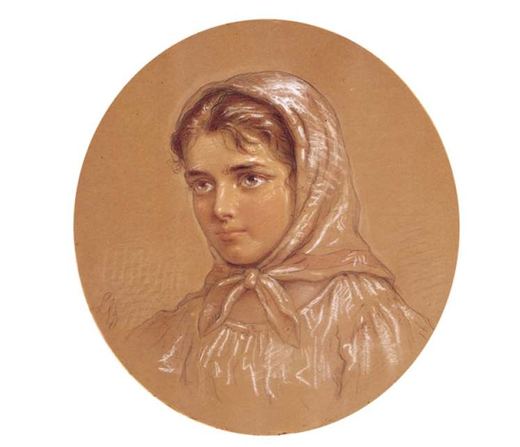
Portrait of a Young Girl
Leonid Florianovich Zhodeyko
1860 · Pencil and pastel on paper · 20 x 25 cm
Leonid Florianovich Zhodeiko belongs to the Russian portraitists of the era of the Great Reforms, a period in which Russian society changed profoundly after the middle of the nineteenth century. His work stands in a milieu in which academic portraiture, bourgeois representation and the growing interest in individual biographies moved closer together. He was not a revolutionary innovator of style, yet precisely his position within the academic portrait tradition makes him meaningful for a collection of Russian art. Zhodeiko was born in 1826 and received his artistic training first with Sergey Zaryanko, one of the important portrait teachers of his time, before studying at the Imperial Academy of Arts in Saint Petersburg.
There he was shaped by the classical academic form that placed drawing, modelling, perspective and the representational conception of the figure at the centre of artistic practice. In 1858 he became an Academician of the Imperial Academy of Arts, a status confirming his professional recognition within the official art system. As a portraitist, Zhodeiko worked at a time when portraits conveyed not only aristocratic self-representation but increasingly also bourgeois, intellectual and institutional identity. His portraits is therefore read in the wider context of Russian reform society: they show persons not as anonymous types, but as bearers of education, office, family status or cultural role. Sources also mention Zhodeiko as an author of popular romances, which situates him as a figure within a broader artistic culture of the nineteenth century.
Zhodeiko's work is based on academic drawing, careful physiognomic rendering and controlled pictorial staging. The portrait figure usually occupies the centre; expression, posture and clothing serve to indicate social and psychological character. Within the logic of the collection, he marks an important line of Russian art before the breakthrough of more radical Realism and the Peredvizhniki.
For I tesori della Russia, Zhodeiko represents nineteenth-century academic portrait culture. His profile helps tell the collection not only through famous avant-garde figures or landscape painters, but also through those artists who recorded the face of Russian society during the reform period.