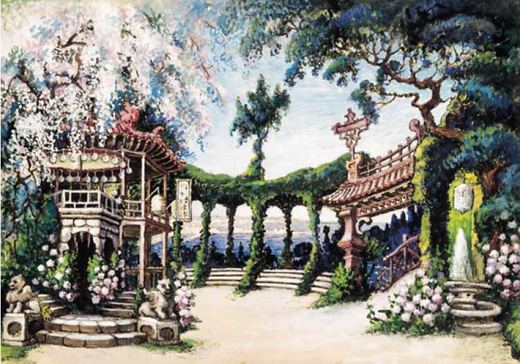
Stage Design for Madama Butterfly at the Imperial Mariinsky Theatre in Saint Petersburg
Konstantin Andrejewitsch Somow
Tempera on paper · 32 x 23 cm
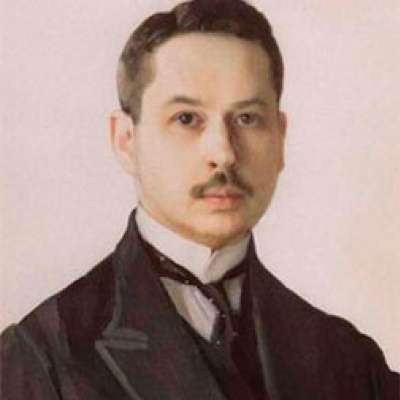
Konstantin Andreevich Somov is one of the major artists of Russian modern art around 1900 and one of the defining figures of Mir Iskusstva, the "World of Art" movement. Born in Saint Petersburg as the son of an art historian and museum professional, Somov grew up in an environment shaped by European culture, courtly memory, literature, music and collecting aesthetics. His art is one of the most refined manifestations of the Russian Fin de Siecle: cultivated, ironic, sensuous, historicising and at the same time unmistakably modern. Somov studied at the Imperial Academy of Arts and also in Paris at the Academie Colarossi. This double formation between Petersburg and Paris is clearly visible in his work. He was less interested in the heroic Realism of the nineteenth century than in fragile worlds of memory, masquerade, courtly elegance and psychological suggestion.
His motifs often lead into park landscapes, interiors, portraits, gallant scenes, book illustrations and decorative compositions that evoke the eighteenth century without becoming merely nostalgic. With Mir Iskusstva, Somov represented a new understanding of art as an integrated culture. Painting, book design, graphic art, theatre, ornament and historical stylisation were not treated as separate categories, but as parts of a coherent aesthetic language. After the Revolution he eventually emigrated to France. His late work and international reception connect Russian modernism with European exile, the art market and the memory culture of the Russian diaspora.
Somov's pictorial language is marked by exceptional elegance of line. He works with delicate drawing, subtle tonal colour, decorative surfaces and a deliberately artificial, theatrical atmosphere. His figures appear not merely as individuals, but as bearers of a cultural game: costume, gesture, gaze, interior and landscape become signs of a refined and at times erotically charged world. Art-historical classification: Art-historically, Somov is a key position between Symbolism, Art Nouveau, Russian book art and European Decadence. His work explains why Russian modern art cannot be reduced to abstraction and the avant-garde. It also includes a highly developed culture of historical reflection. In Somov's works, the past is not documented; it is aesthetically staged and psychologically refracted.
For I tesori della Russia, Somov is an artist of the highest curatorial relevance. He opens the collection context to the art around 1900, to the culture of Petersburg aestheticism and to international modernism. His work is especially well suited to showing visitors that Russian art means not only national landscape, icon, Realism or avant-garde, but also refinement, decadence, historical fantasy and cosmopolitan elegance. The international museum context - including references at Tate and the Metropolitan Museum of Art - strengthens his importance for a public catalogue intended to speak to highly informed art audiences.