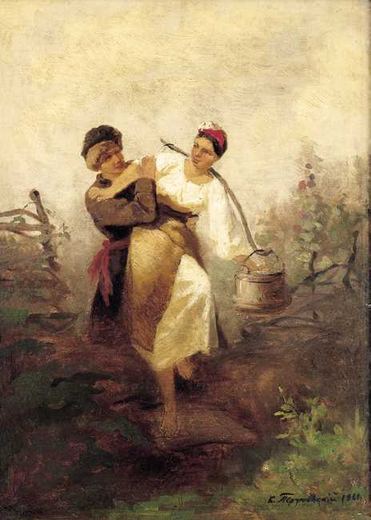
Young Woman Carrying Water
Konstantin Alexandrovich Trutovsky
1861 · Oil on canvas · 40 x 56 cm
Konstantin Aleksandrowitsch Trutowskij is one of the important Russian genre painters and graphic artists of the mid-nineteenth century. His work stands at a decisive transition: from academically shaped pictorial culture toward a stronger observation of folk life, social milieus and the literary world of narrative. He was born in Kursk and first received an education that was not directly directed toward art: he attended the Saint Petersburg military engineering school, where Fyodor Dostoevsky was among his circle. Later he attended classes at the Imperial Academy of Arts. Trutowskij became known above all for depictions of rural life, markets, festivities, folk customs, estate-owner milieus and Ukrainian-Russian scenes of everyday life. His art is narrative, observant and often marked by a fine sense of character and situation.
Unlike the later socially critical painting of the Peredvizhniki, his view is not always accusatory; he often combines realism with humour, ethnographic interest and narrative pleasure in types and customs. Another central side of his work is illustration. Trutowskij illustrated, among others, works by Gogol, Krylov, Pushkin, Lermontov and Taras Shevchenko. This connection between image and literature makes him especially interesting for Russian art history. He belongs to the artists who helped shape the visual imagination of literary nineteenth-century Russia and translated the folk and narrative world of literature into drawing and graphic art. The Russian Museum identifies Trutowskij as a painter, graphic artist, master of genre and illustrator of Ivan Krylov's fables. Culture.ru emphasizes his reputation as a book illustrator and graphic artist.
He is therefore not only a genre painter, but an artist who connected several cultural media: painting, drawing, literature, ethnography and the early national pictorial culture of Russia.
Trutowskij's pictorial language is narrative and observational. Figure constellations, gestures, clothing and social situations form the core of his art. In his best works, a lively panorama of rural and semi-aristocratic life emerges, making social hierarchies, regional identities and everyday culture visible. Art-historically, he is an important precursor or neighbour of Russian Realism: he does not simply belong to the later Peredvizhniki movement, but prepares central interests such as folk life, social types, everyday life, regional culture and literature-shaped narrative.
The source list names the Tretyakov Gallery, the Russian Museum, art museums in Kursk, Kyiv, Kharkiv and Odessa, regional collections of Dusseldorf or academic-realist after-effects, museums of folk life and ethnographic painting, literary museums and collections of graphic art and drawing. This breadth corresponds very closely to Trutowskij's profile. For I tesori della Russia, he opens the collection narrative from the academic nineteenth century toward realist and literary Russian visual culture.