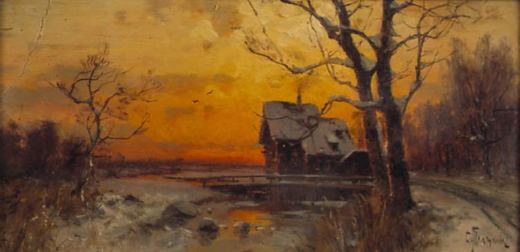
Izba at Sunset
Khariton Platonovich Platonov
1890 · Oil on cardboard · 36 x 18 cm
Khariton Platonovich Platonov belongs to the Russian genre painters of the late nineteenth century whose work translated everyday life, childhood, rural existence and social observation into an academically trained pictorial form. Born in 1842 into a peasant family in the Yaroslavl Governorate, his biography already embodies a form of social ascent that the nineteenth-century art academy could enable under certain conditions. Platonov studied at the Imperial Academy of Arts in Saint Petersburg from 1859 to 1870 and received several awards during his training. After graduating, he first worked as a drawing teacher in Tsarskoye Selo and later developed into an important educator. In 1877 he moved to Kyiv, where he taught for many years at the drawing school. In 1893 he was named an Academician of the Imperial Academy of Arts. In his painting, Platonov concentrated on scenes of simple life, child figures, female labour and servant motifs, and rural milieus. Works such as Lakomka, Village Children or The Little Nurse stand for a conception of genre painting that is not purely anecdotal, but seeks the social and emotional legibility of its figures. In Platonov's work, children and ordinary people are not monumentalised, but treated with a quiet sense of gesture, gaze and everyday situation.
Platonov's pictorial language combines academic drawing with a warm, narrative form of genre painting. He works with clear figure arrangements, legible gesture and an interest in milieu and social detail. The psychological effect often arises not from dramatic action, but from small observations: a posture, a glance, a task, or the relationship between a child and the surrounding space. Art-historical classification: Art-historically, Platonov represents the humane and socially observant branch of Russian genre painting within an academic framework. His work belongs to the nineteenth-century culture in which ordinary life, childhood and rural experience became subjects worthy of serious pictorial treatment.
For I tesori della Russia, Platonov represents the humane and socially observant strand of Russian genre painting. His inclusion allows nineteenth-century Russian art to be told not only through great landscape and history, but also through everyday life, pedagogy, childhood and the quiet dignity of simple worlds of life.