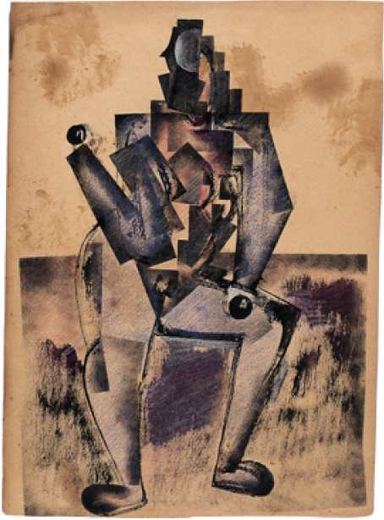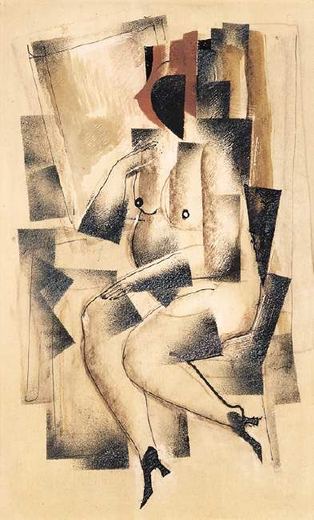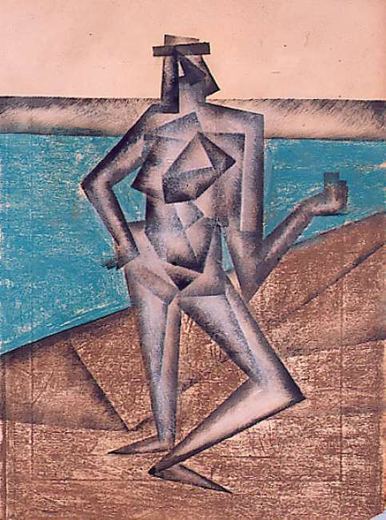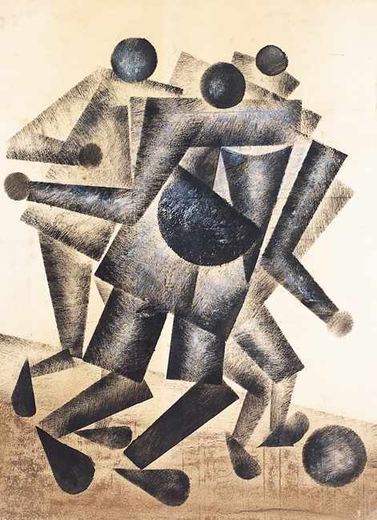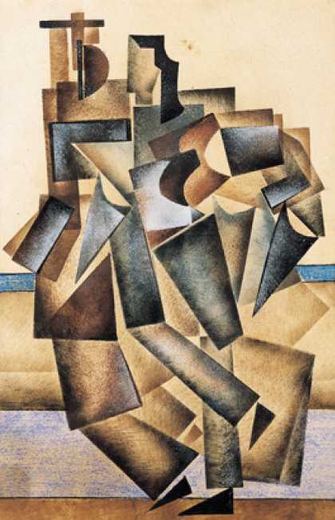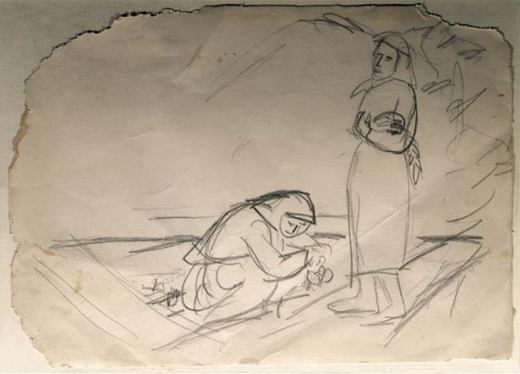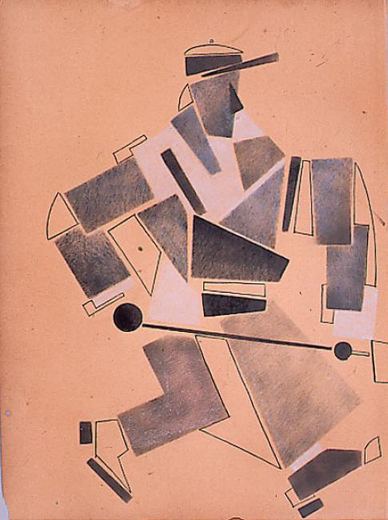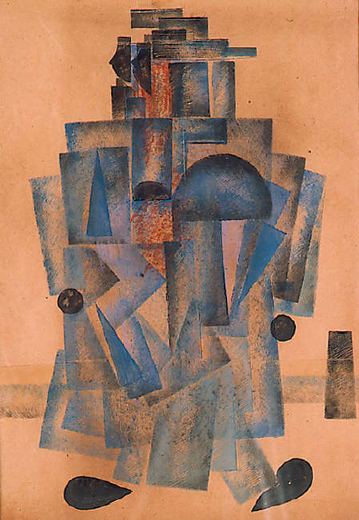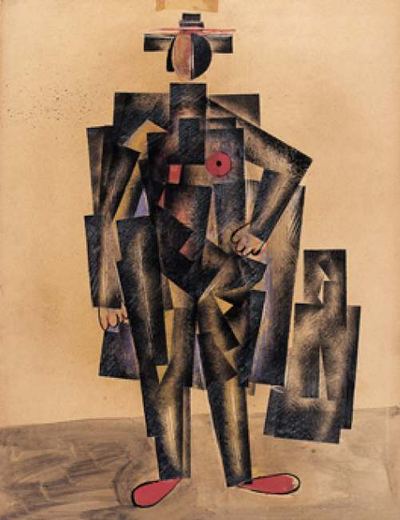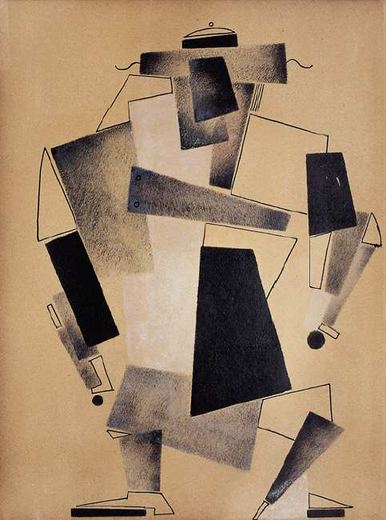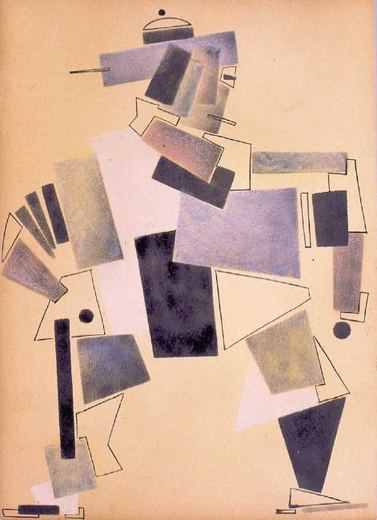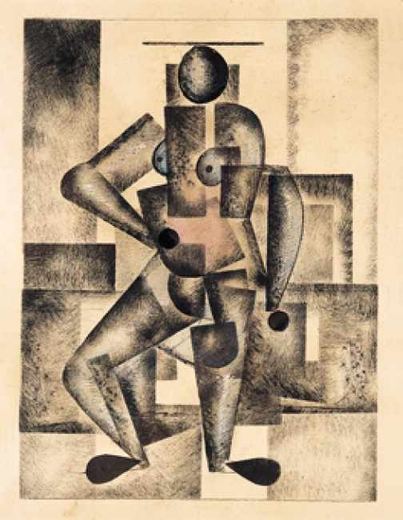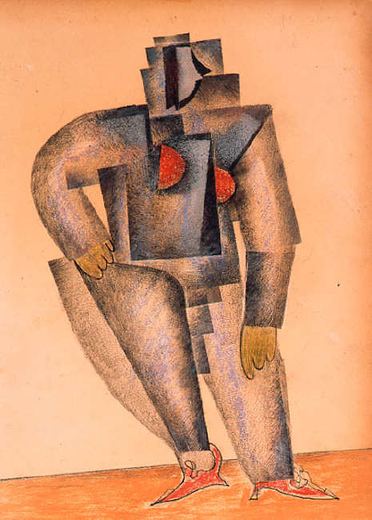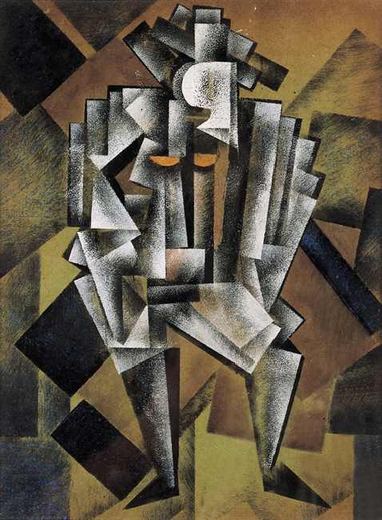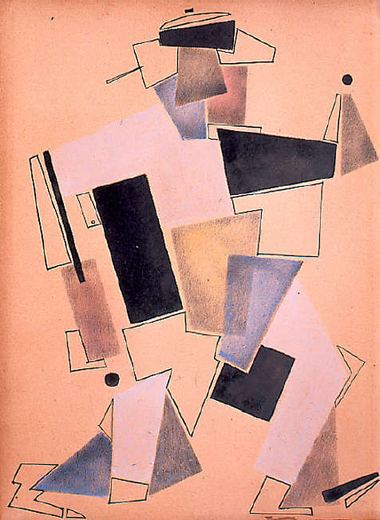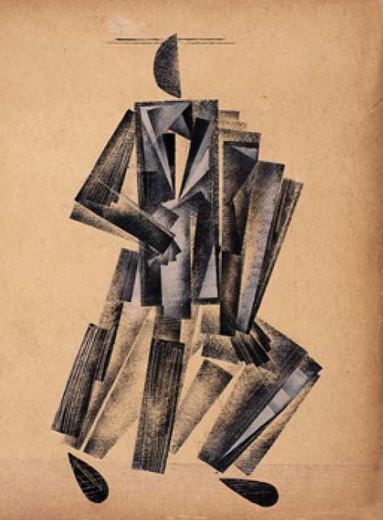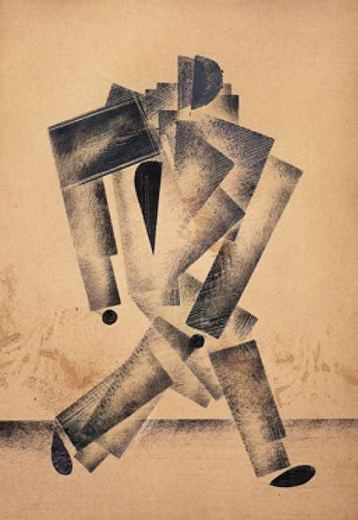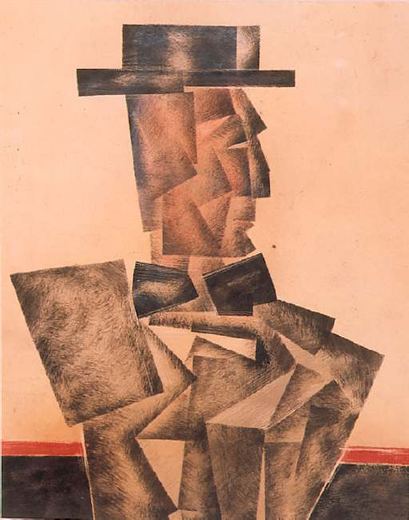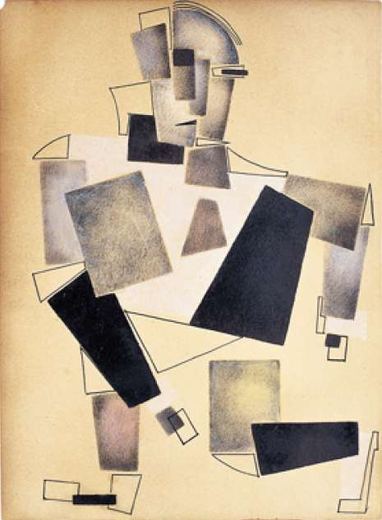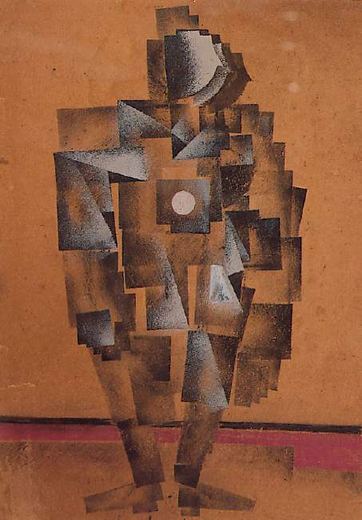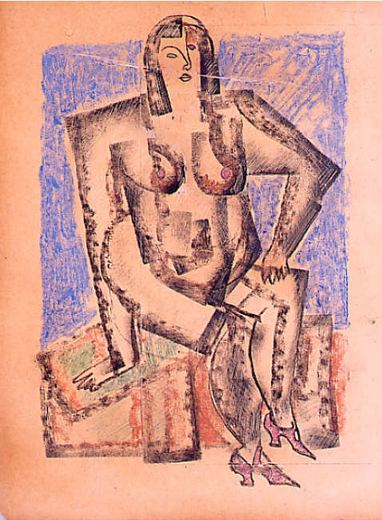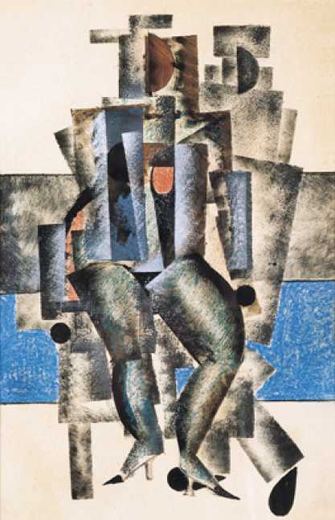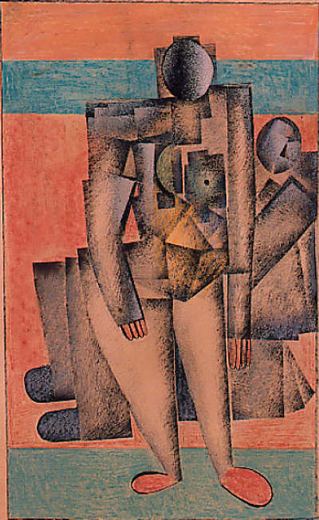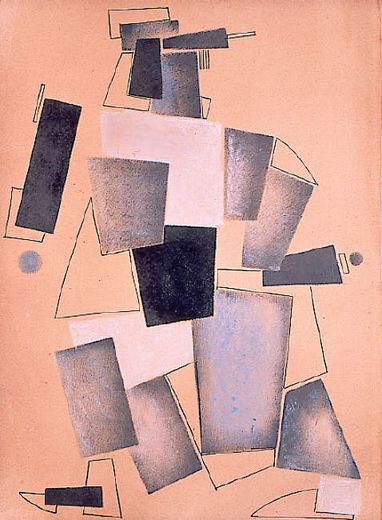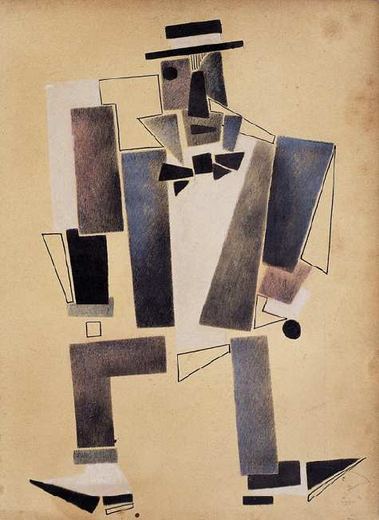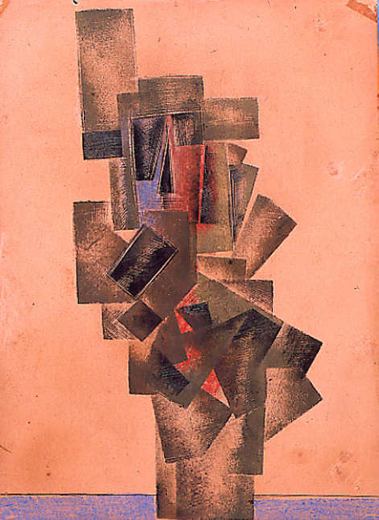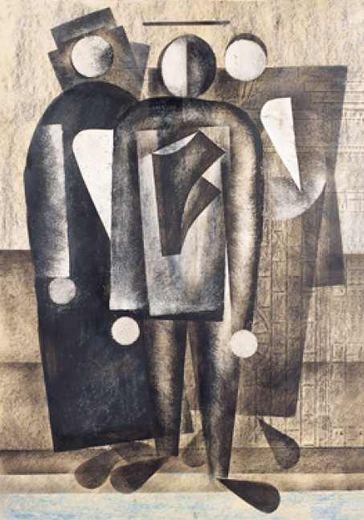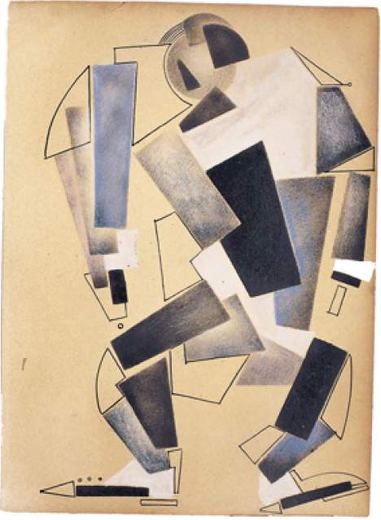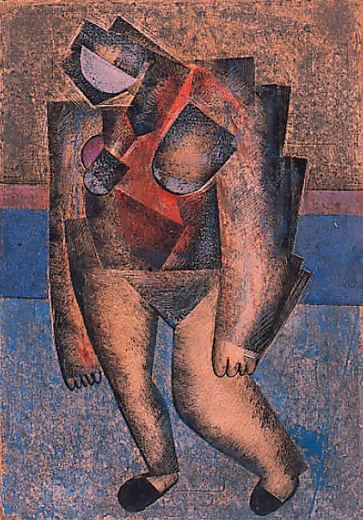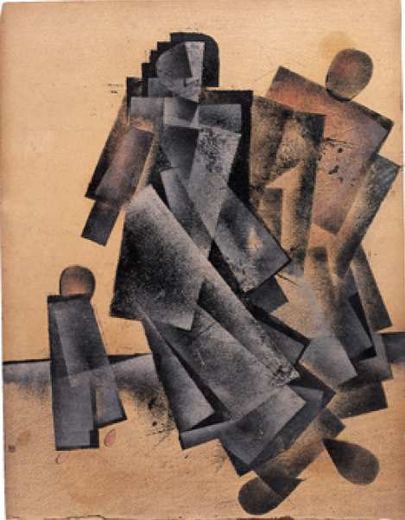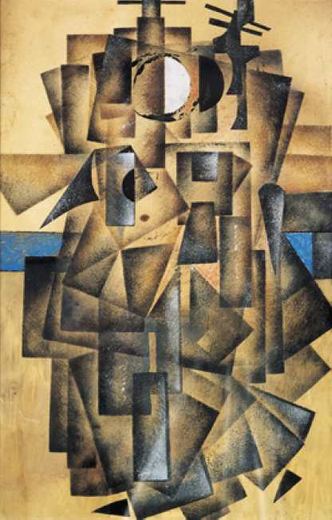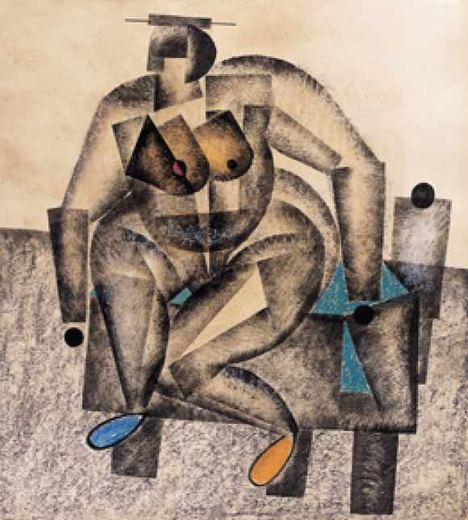
Nude in an Armchair
Kazimir Severinovich Malevich
c. 1920 · Mixed media on paper · 30 x 37 cm
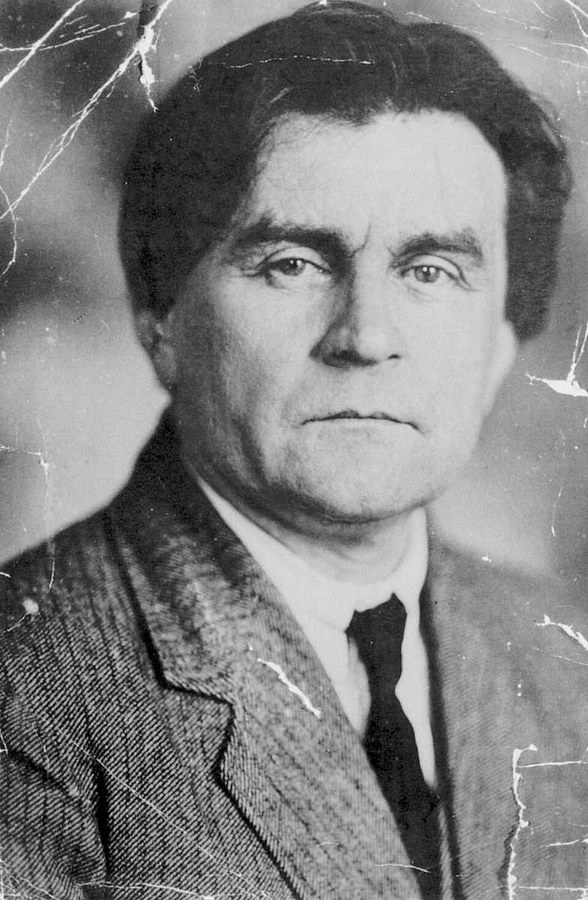
Kazimir Malevich is one of the central figures of twentieth-century art history. His name stands not only for the Russian Avant-Garde, but for one of the most radical moments in modern art altogether: the detachment of the image from the representation of external reality. With Suprematism, developed from 1915 onward, Malevich formulated a system of non-objective painting in which geometric forms, colour, emptiness and the plane become carriers of a new, spiritually conceived pictorial order. No artist in the collection requires a more precise art-historical framing than Malevich, because his work is at once aesthetic revolution, theory and cultural symbol.
Malevich was born in the Kyiv region into a family of Polish origin and moved artistically within a complex cultural field: Ukrainian landscape and folk culture, Russian metropolitan centres, European modernism, the icon tradition and revolutionary utopia. This multilayered identity is consciously preserved in a public catalogue. Malevich cannot be reduced to a single national formula. He belongs to the Russian Avant-Garde, emerged at the same time from the Ukrainian cultural sphere, and stands within a transnational network of modern art. His early development passed through several phases. Impressionist, Symbolist and Primitivist elements appear alongside influences from the icon, the lubok, folk art and French modernism. Around 1912/13, in his Cubo-Futurist works, he reached a dynamic fragmentation of form.
Figures, machines, peasant bodies, lettering and motion appear as fields of force. In this phase, Malevich was already no longer an academic painter, but an artist experimentally dismantling the very foundations of the image. The year 1915 marks the decisive rupture. At the 0,10 exhibition in Petrograd, Malevich presented his Suprematist paintings, among them the famous Black Square. This work is not understood as mere reduction. It is a modern substitute for the icon, a zero point of form and an assault on the expectation that painting must depict something visible. For Malevich, Suprematism means the supremacy of pure feeling in the visual arts. Square, circle, cross, floating rectangles and coloured geometric bodies form a world without narrative objects, but with a powerful metaphysical claim. After the Revolution, Malevich became a teacher, organiser and theorist.
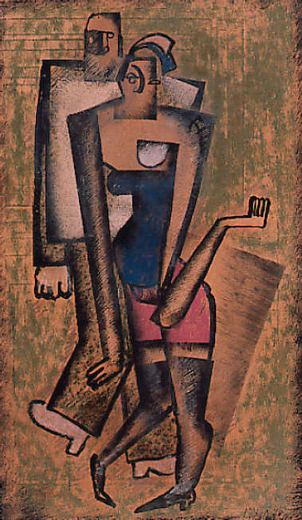
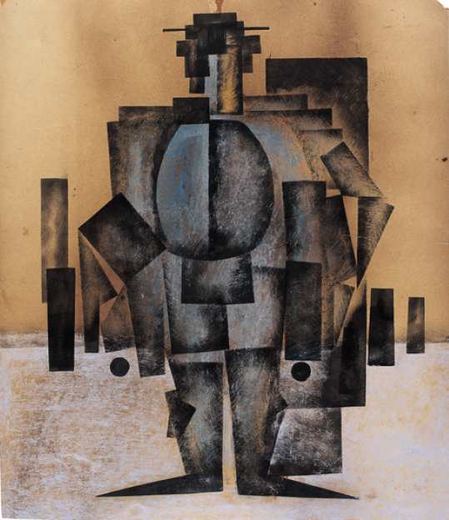
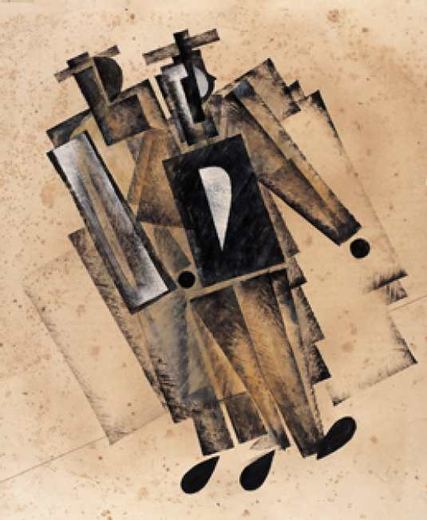
In Vitebsk he founded, together with his students, the group UNOVIS, which sought to extend Suprematist principles into design, architecture, book production, propaganda and everyday life. Here lies a fundamental difference between Malevich and a purely formalist understanding of abstraction: Suprematism was not only a style, but a model for a new visual order. His teaching in Vitebsk, Petrograd/grad and Kyiv made him a driving force of avant-garde pedagogy. In the late 1920s and 1930s the situation changed dramatically. Political conditions in the Soviet Union became increasingly hostile to abstract art. Malevich was arrested in 1930, and his art came under pressure. His late figurative works - often with block-like peasant figures, empty faces and quiet monumentality - is not misunderstood as a simple return to the object.
They are a tragic and complex late form of his art: the figure returns, but it stands in a world that has already lost the utopian freedom of the early Avant-Garde.
Malevich’s oeuvre is defined by extreme ruptures. The early work combines peasant corporeality and modern formal decomposition. The Cubo-Futurist phase condenses movement, writing, machine and body into charged pictorial organisms. Suprematism, by contrast, reduces visual language to elemental signs: square, circle, cross, line, colour and plane. The decisive tension is that between ascetic form and metaphysical ambition. Malevich does not paint geometrically in order to be cool or detached; he seeks an art beyond the object, one that appears as a new spiritual reality. For international modernism, Malevich became an originating point of abstract art. His influence reaches from geometric abstraction through Minimal Art to Conceptual Art and architectural theory. Museums such as MoMA, Tate, the Stedelijk and the Guggenheim position him not only as a Russian artist, but as a canonical figure of world modernism.
For I tesori della Russia, Malevich is a load-bearing pillar. He elevates the collection from the field of historical Russian painting into global art history. His presence signals that the collection does not merely represent national schools, genre, landscape or illustration, but also those moments in which Russian art redefined modernism internationally. Within the context of the first ten artists, Malevich also forms a productive field of tension with Lebedev and Tatlin. Lebedev translates the Avant-Garde into book and graphic design; Tatlin into material, construction and architectural utopia; Malevich formulates the metaphysical and theoretical axis of non-objectivity. Together, these positions make visible the Russian Avant-Garde as one of the most important laboratories of modernism.