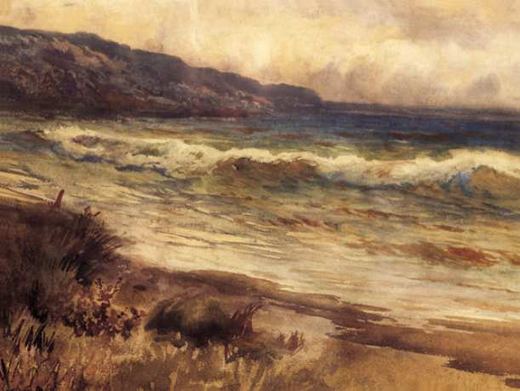
Topografie
Karl Eduardovich Geftler
Watercolor on paper · 46 x 34 cm
Karl Eduardowitsch Geftler is an interesting marginal and bridging figure in Russian art of the late nineteenth century. He was an architect and watercolourist of Baltic-German origin who was rooted in the artistic life of the Russian Empire. His work connects architectural training, travel observation, city views and landscape watercolour. He is therefore not one of the major programmatic painters of Russian art history, but he has clear value for a differentiated collection: he shows the significance of watercolour, architectural veduta and drawn travel documentation within Russian visual culture. Geftler was born in Reval and received architectural training in Saint Petersburg. His artistic practice developed in parallel with architecture: he produced watercolours and views of Saint Petersburg, Moscow, Crimea, the Caucasus and many European places.
The combination of construction, visual direction and atmospheric watercolour is characteristic of his work. As an architect he understood spaces, buildings and perspective not only pictorially but also structurally; as a watercolourist he transformed this perception into light, often travel-like pictorial forms. His importance lies less in radical stylistic innovation than in the quality of cultivated observation. Geftler's views preserve places, urban landscapes and architectural situations in a form that lies between artwork, memory and topographical witness. For the nineteenth century in particular, when travel, technical mobility, imperial geography and the collecting of views became increasingly important, this art form is far from secondary. Watercolours such as Geftler's belong to the visual infrastructure of an educated, mobile and cosmopolitan art culture.
For I tesori della Russia, Geftler can broaden the collection by adding the dimensions of architecture, travel and watercolour. He is not suited to presentation as a canonical main name, but as a precisely placed specialist position. A work by Geftler can draw visitors' attention to the diversity of Russian art beyond oil painting and major movements: to works on paper, vedute, Baltic-German intersections and the aesthetic culture of looking at cities and landscapes.
Geftler's work is shaped by an architectural eye, light watercolour technique and an interest in city and landscape views. His works combine topographical precision with atmospheric representation. His position as an architect-watercolourist within Russian paper and travel culture of the late nineteenth century is especially important.
The source list names the Pushkin Museum in Moscow, collections of Russian architectural and landscape watercolours, holdings in Saint Petersburg and art collections with a focus on the nineteenth century. For I tesori della Russia, Geftler can serve as a specialist profile for watercolour, architectural veduta and Baltic-Russian cultural interconnection.