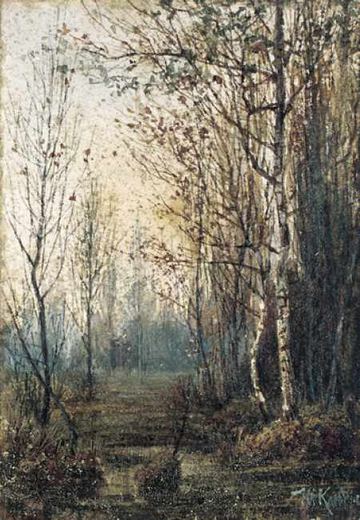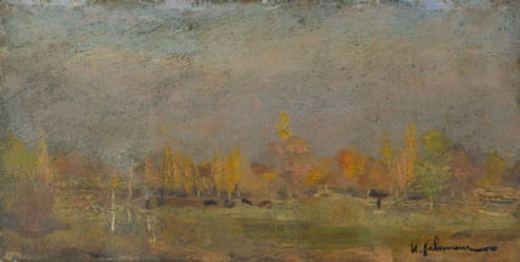
Autumn
Julius Sergius von Klever / Yuly Yulyevich Klever
Oil on wood panel · 22 x 11 cm
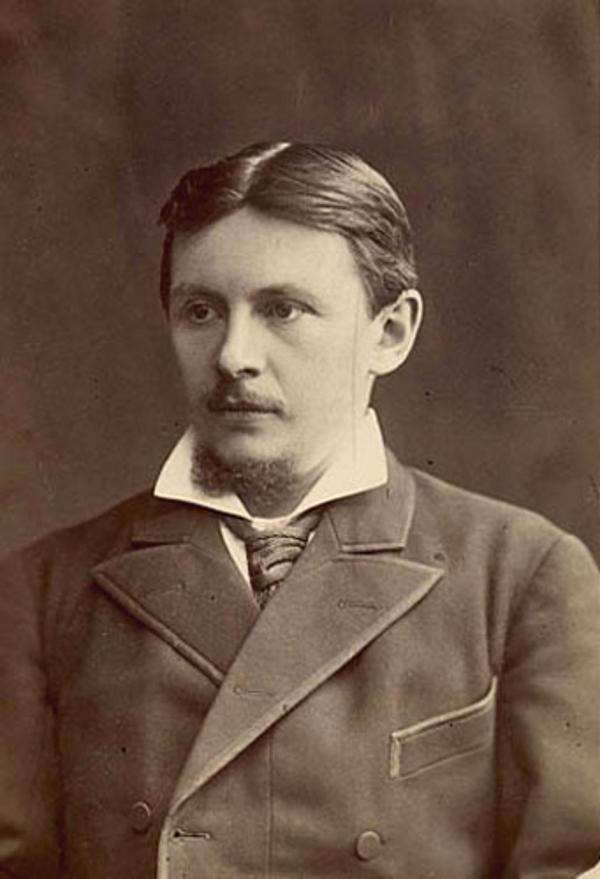
Julius Sergius von Klever, known in Russia as Yuly Yulyevich Klever, occupies a distinctive position within Russian landscape painting of the late nineteenth century. As an artist of Baltic German origin, he united the Petersburg academic tradition with a highly atmospheric, at times almost theatrical understanding of nature. His winter landscapes, evening moods, marsh and forest scenes, and snow-covered roads belong to the most popular image types of Russian salon and collecting culture around 1900. Klever was born in Dorpat, now Tartu. He studied at the Imperial Academy of Arts in Saint Petersburg, initially architecture at his father's request, but soon turned to landscape painting. His teachers included Sokrat Vorobiev and Mikhail Klodt, both representatives of an academically grounded landscape school. Klever's career developed with unusual speed.
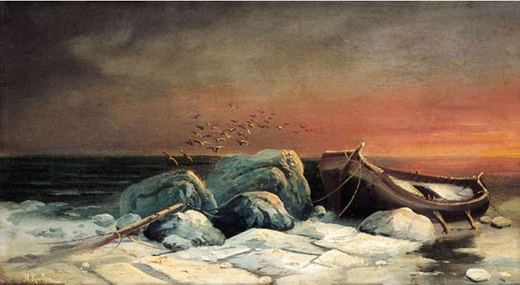
Already in the 1870s his works attracted the attention of collectors and members of the imperial family. In 1878 he became an Academician, and later a professor of the Academy. He thus belonged to those artists whose success was sustained both by official recognition and by strong private demand. Klever's landscapes differ markedly from Shishkin's sober analysis of nature. Where Shishkin records the structure of the natural world almost scientifically, Klever seeks the emotional climate of the motif. His preferred field is the moment of transition: twilight, an approaching storm, winter stillness, the low sun, the last brightness over ice and snow. His pictorial spaces often appear like stages of nature, where light and shadow assume a dramatic role.
It was precisely this staged atmosphere that made his works highly accessible in the international art market of the late nineteenth century. It would nevertheless be reductive to treat Klever merely as an agreeable salon painter. His work documents an important current within Russian landscape art: the union of academic skill, a romantic concept of nature and a pictorial effect attractive to collectors. His paintings do not create a socially critical reality or an avant-garde revolution of form, but a poetic world of nature in which the landscape itself becomes an emotional event. In the history of Russian art, Klever therefore represents a taste that mediated between the official Academy, affluent private collecting culture and the international exhibition system.
Klever's work is defined by strong direction of light, clearly recognisable motif types and a pronounced sense of atmospheric effect. Paths, groups of trees, bodies of water and snowfields often appear as compositional axes that draw the eye deep into the landscape. The winter pictures in particular depend on contrasts between cold, bluish shadow and warm reflections of the setting sun. The painterly surface is usually less analytical than in the great realists of the Peredvizhniki; it seeks instead the emotional condensation of the moment. This quality explains Klever's broad appeal among private collectors, as well as the continuing presence of his work in the auction and gallery context. A note on workshop participation and variants is important in Klever's case: because of his popularity, many repetitions and works from the orbit of his studio were produced, so attribution and provenance must be carefully examined for individual works.
For I tesori della Russia, Klever is especially valuable because he makes visible another side of Russian landscape art than Shishkin, Dubovskoy or Levitan. He stands for the romantic-atmospheric and internationally communicable landscape, for the aesthetics of collecting, and for the high demand for Russian images of nature in the late imperial period. Within the collection, Klever allows the tension between academic recognition, popular taste and museum standing to be narrated convincingly.