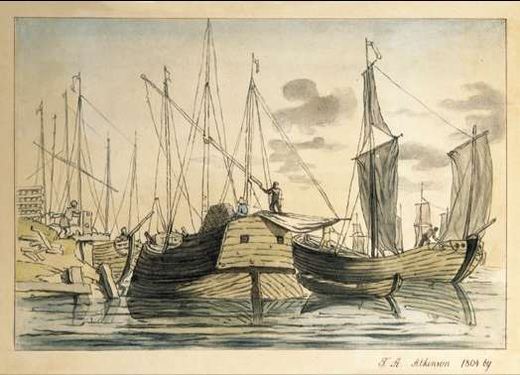
Sailing Ship
John Augustus Atkinson
1804 · Pencil and watercolor on paper · 22 x 15 cm
John Augustus Atkinson is a distinctive figure within a collection of Russian art because he was not a Russian artist in the strict national sense, but he was one of the most important Western image-makers of Russian subjects around 1800. The London-born painter, draughtsman, watercolourist and etcher came to Saint Petersburg as early as 1784 and spent formative years of youth and training there. His later published depictions of Russian manners, costumes, games, landscapes and military scenes had a lasting influence on the Western European image of Russia. Atkinson came to Russia in the orbit of James Walker, who served as an engraver at the court of Catherine II. In Saint Petersburg, Atkinson was able to study the imperial collections and received support from the court. He painted portraits and Russian historical and military subjects.
When he returned to England around 1801, he brought with him a rich visual archive of Russian observations. In 1803 he published “A Picturesque Representation of the Manners, Customs, and Amusements of the Russians” with 100 plates. This work became one of the best-known graphic sources for European ideas of Russia at the beginning of the nineteenth century. Atkinson's significance lies precisely in the tension between observation and translation. He did not show Russia from the perspective of a native artist, but through the eye of a British draughtsman who had lived long enough in the country to gather motifs, clothing, gestures and social types, while still working for a Western audience. His images can therefore be read in two cultural directions: as records of Russian everyday, costume and military culture, and as products of a European imagination of Russia.
The British Museum lists Atkinson as etcher, painter and draughtsman and emphasises his residence in Russia from 1784 to 1802. Tate identifies him as an English artist, engraver and watercolourist. This institutional framing shows that Atkinson is relevant both to British art history and to the history of representations of Russia. His works are held in important graphic and maritime collections, including the British Museum, Tate and the National Maritime Museum. For I tesori della Russia, Atkinson is especially valuable because he introduces the external gaze into the collection. Russian art history consists not only of Russia's self-images, but also of European images about Russia. Atkinson shows how the Russian Empire around 1800 was perceived as culturally rich, militarily significant and ethnographically fascinating.
His works can create a productive contrast alongside Russian artists: while Russian artists formulated their own landscape, history and society, Atkinson reveals how Russia was read, collected and circulated internationally. An Atkinson profile therefore not appear as a foreign body within the collection, but as part of the international reception history of Russian culture. His images connect Enlightenment curiosity, travel imagery, courtly connections, costume studies and British printmaking into an important chapter of visual knowledge about Russia.
Atkinson's work is graphic, precise, narrative and observational. His Russian subjects show figures, costumes, social scenes, games, military types and landscape settings. As a watercolourist and etcher, he translated direct observation into a publishable image format. The visual language is frequently clear, detailed and oriented toward intelligibility for a European audience. Art-historically, Atkinson belongs to British watercolour and print culture, but also to the history of the visual representation of Russia. His works are important sources for the Western view of Russia around 1800 and stand between art, ethnography, travel account and visual diplomacy.
For I tesori della Russia, Atkinson brings in an international perspective. He shows how Russia was seen from outside and disseminated through Western print culture. This expands the concept of the collection: not only Russian artists depicting Russia are relevant, but also artists who helped shape Russia's image in European consciousness. For a sophisticated audience, this shift of perspective is curatorially valuable.