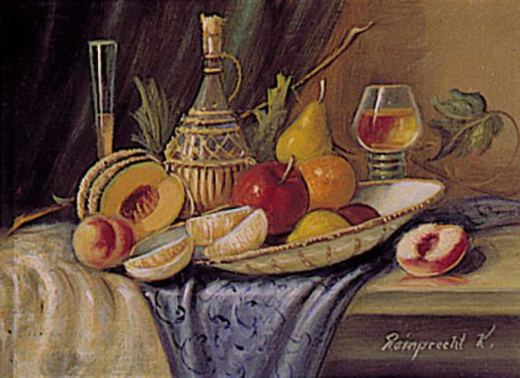
Fruit and Wine
Johan Karoly Reinprecht / Johan K. Reinprecht
Oil on wood panel · 18 x 23 cm
Johan Karoly Reinprecht is one of the most source-critical entries in this block. Unlike the canonical Russian artists in the collection, no robust museum biography has been identified for him; the verifiable information comes largely from art-market and auction contexts. In those records he appears as a Hungarian artist, born in 1903, often with signature forms such as Johan K. Reinprecht or Reinprecht J. K., and with small-format still lifes in oil on panel, board or canvas. The preserved or market-documented works usually show fruit, flowers and table still lifes, occasionally with window views, drapery, jugs, wine or serving objects. This motif world does not belong to Russian art history in the strict sense, but to a broader Central European decorative painting tradition of the twentieth century.
That is precisely the central curatorial question: why is a work by Reinprecht present in a collection titled I tesori della Russia? Possible explanations may lie in provenance, acquisition history, the biography of the collection, or a thematic connection within a broader European holding. For a professional public catalogue, Reinprecht is not artificially integrated into the Russian tradition. The high-quality treatment of this entry consists instead in keeping the source situation transparent and presenting the artist as a Central European supplementary position or as a marginal position still requiring object-level review. This approach is especially important for demanding art circles. Quality here does not arise through overstatement, but through precise delimitation.
A source-critical profile avoids giving the impression that the collection is forcing every object into a Russian national narrative regardless of evidence. Reinprecht can therefore remain a useful catalogue entry if he is framed correctly: not as a key artist of Russian art, but as a collection-context, comparison or provenance position whose exact relevance must be established through the object itself.
Reinprecht's documented still lifes follow a classical decorative logic. Fruits, flowers, vessels and textiles are arranged in calm compositions; the painting aims more at atmosphere, domestic intimacy and collectability than at avant-garde innovation. The works belong to a tradition in which still life continues as a private, intimate and craft-conscious genre. Art-historically, Reinprecht is not presently documented well enough to be presented on the same level as the Russian museum artists in the collection. His position is rather that of a Central European still-life painter whose attribution and collection relevance is checked. In catalogue terms, this can become a professional strength if the entry is treated as an example of careful provenance work rather than as an inflated claim.
The concrete relationship to I tesori della Russia is formulated at object level. Reinprecht probably does not belong to the core of Russian art history, but he may appear as a Central European collection position, acquisition trace or comparison work within the collection. Before any prominent public presentation, the provenance of the specific work is reviewed.