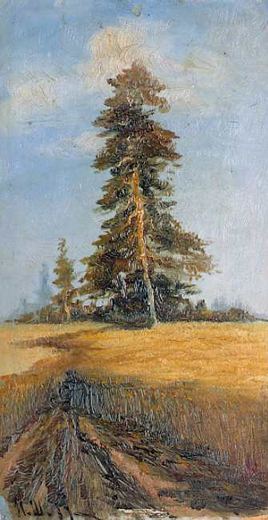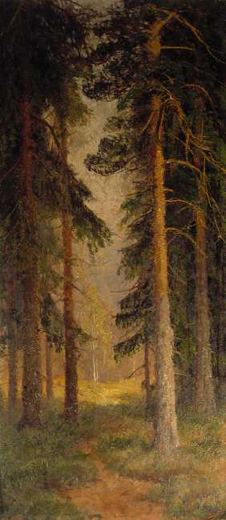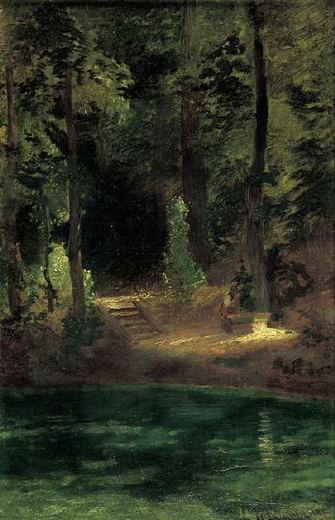
By the Bank
Ivan Ivanovich Shishkin
Oil on canvas · 30 x 46 cm
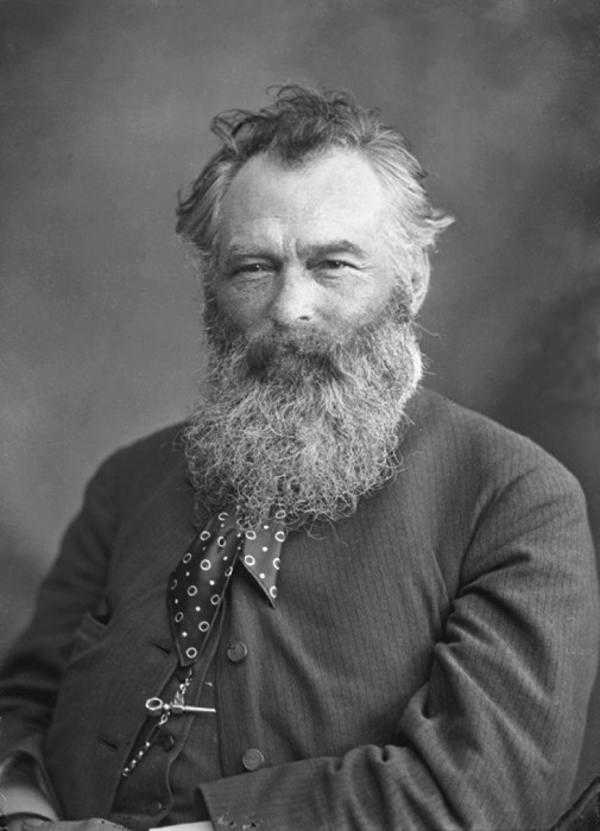
Ivan Ivanovich Shishkin is one of the central figures of nineteenth-century Russian landscape painting. Few artists united scientifically precise observation, academic mastery and a national consciousness of landscape as convincingly as he did. His forests, woodland paths, clearings, riverbanks and broad fields are not neutral views of nature, but pictorial formulations of a Russian landscape that, in the late imperial period, became a bearer of cultural identity. Already his contemporaries called him the "Tsar of the Forest" - a phrase that refers not only to his preferred subjects, but also to the monumental authority with which he translated trees, vegetation and forest architecture into painting and graphic art. Shishkin was born in Yelabuga in the former Vyatka governorate landscape.
After studying at the Moscow School of Painting, Sculpture and Architecture, he continued his training at the Imperial Academy of Arts in Saint Petersburg. Academic education gave him technical precision, while his stays in Germany and Switzerland sharpened his awareness of European landscape traditions. His engagement with drawing and printmaking was especially important. In Zurich he learned the technique of etching, and his entire oeuvre reveals exceptional draughtsmanship. In painting he developed from this a language in which every trunk, every passage of foliage and every structure of the forest floor is clearly built, without the pictorial effect collapsing into mere detail realism. Art-historically, Shishkin stands at the intersection of the Academy and realist renewal.
As a founding member of the Peredvizhniki, or Wanderers, he belonged to the movement that brought art out of the courtly-academic sphere and into a wider public. Yet his realism differs from the social-psychological realism of Repin or the narrative realism of Makovsky. In Shishkin, the dramatic element lies not in an event, but in nature itself: in the weight of a pine forest, in the direction of light across a summer landscape, in the vertical order of tree trunks, in the stillness of the forest interior. His nature appears objectively observed and at the same time symbolically charged. It is particularly important that Shishkin did not treat the Russian landscape as a picturesque accessory, but endowed it with monumental dignity. In works such as Rye, Morning in a Pine Forest, In the Wild North and Polesye, nature becomes the principal actor. Shishkin's gaze is never sentimental.
He idealises not through softness, but through concentration, structure and painterly authority. This union of accuracy and grandeur makes his work to this day a key to understanding Russian landscape art.
Shishkin's visual language rests on extraordinary draughtsmanship. His compositions are often constructed from clear vertical and horizontal structures: tree trunks, paths, openings of light and horizon lines form a stable framework. Characteristic is the minute, almost botanical working-through of vegetation. Yet this precision does not serve dry documentation. It creates a sense of duration, rootedness and spatial depth. Shishkin paints nature as an order of its own. His printmaking is as important for his art-historical classification as his oil paintings. In etchings and drawings, it becomes clear how strongly his thinking is shaped by the relationship between line and image. Landscape in his work does not arise primarily from atmospheric dissolution, but from construction, contour and the modelling of light. Precisely for this reason, his painting often appears at once realistic and monumental.
For I tesori della Russia, Shishkin is an indispensable point of reference because he formulates the Russian landscape as cultural memory. Within the collection, his name can be read as a bridge between academic training, national pictorial imagination and realist modernity. His presence in major Russian and international collections confirms the museum rank of his work. In a public catalogue, Shishkin is therefore presented not merely as a landscape painter, but as one of the defining image-makers of the Russian idea of nature.