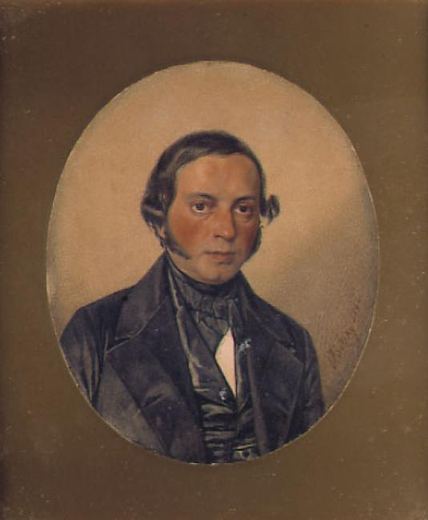
Portrait of a Gentleman
Jan Chrucki / Ivan Fomich Khrutsky / Ivan Khrutsky
1844 · Oil and watercolor on paper · 10 x 15 cm
Jan Chrucki, known in Russian art history as Ivan Fomich Khrutsky, is one of the most important masters of still life in the Russian-Belarusian cultural sphere of the nineteenth century. His biography connects Polish-Belarusian origins, Russian academic training and a visual language situated between domestic intimacy, civic representation and virtuosic painting of objects. His still lifes with fruit, flowers, vessels, honeycombs, candles or game made him an outstanding figure in a genre that was often treated as minor in the academic hierarchy, but which in his work acquires remarkable dignity and presence. Khrutsky was born in 1810 in Ulla in the Vitebsk Governorate, in present-day Belarus. He came from a Polish-Belarusian family and first received an education in Polotsk before moving to Saint Petersburg.
There he came into contact with the Imperial Academy of Arts and with the great European painting tradition, especially through copying Dutch and Flemish masters in the Hermitage. This experience is decisive for his still life painting: the precision of surfaces, the handling of light, the sensuous fullness of objects and the quiet order of the composition recall older European models while being translated into a Russian-Belarusian context. In 1839 Khrutsky became an academician. He was particularly successful in the 1840s and 1850s. His still lifes were admired for their technical brilliance, clear composition and warm domestic atmosphere. At the same time, he produced portraits, interiors and religious works. From 1845 onward he lived primarily on his estate at Zakharnichi near Polotsk.
This withdrawal from the capital did not mean a loss of artistic quality; instead, it intensified the connection of his work with the themes of the house, the family and the quiet world of everyday life. Modern research has re-evaluated Khrutsky. In 2010/2011 the Tretyakov Gallery devoted a bicentenary exhibition to him in collaboration with the National Art Museum of the Republic of Belarus. More recent exhibitions and essays emphasise that his still lifes are not merely decorative arrangements. They articulate a culture of objects: fruits, flowers, tableware and interiors become signs of order, prosperity, transience and domestic identity. For an art collection, Khrutsky is especially interesting because he leads the concept of Russian art beyond ethnic and national boundaries. He belongs simultaneously to Belarusian, Polish and Russian art history.
This multiple affiliation is not a marginal issue, but part of his significance. His work shows how the empire overlaid cultural spaces and how artists operated between languages, regions and institutions.
Khrutsky's still lifes are distinguished by clear compositional order, luminous materiality and an almost tactile presence of the depicted objects. Fruits, flowers, glass, metal, paper, feathers or wax do not appear as arbitrary decoration, but as carefully balanced pictorial objects. Lighting and surface are decisive: the things become physically experienceable and at the same time are brought into a calm, almost contemplative order. His portraits and interiors extend this world of objects into human and spatial relationships. Frequently an atmosphere of domestic culture emerges in which person, object and room together formulate a social identity. Art-historically, Khrutsky therefore belongs among those artists who elevated the seemingly minor genres of the nineteenth century into bearers of cultural significance.
For I tesori della Russia, Khrutsky is a highly valuable building block because he connects still life, domestic culture and the multilingual periphery of the Russian Empire. He permits a presentation of Russian art that includes not only Moscow and Petersburg, but also Belarus, Poland, the Academy, study in the Hermitage and private life-worlds. His profile has particular educational value for an art-informed audience.