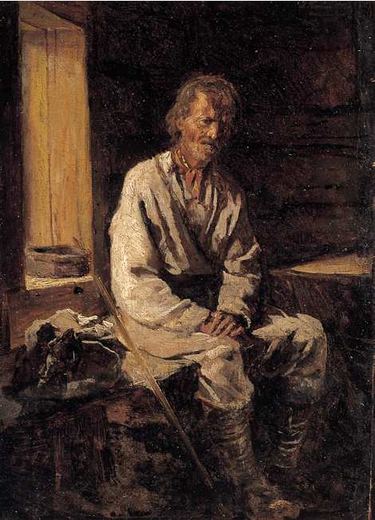
The Old Man by the Window
Ivan Andreevich Pelevin
1899 · Oil on wood · 25 x 35 cm
Ivan Andreevich Pelevin represents that multilayered Russian art of the late nineteenth century in which academic training, Realist genre painting and monumental ecclesiastical art existed side by side. He was a painter and mosaicist, an Academician of the Imperial Academy of Arts and one of the more productive genre painters of his time. His work turns toward everyday life, social roles, peasant and domestic situations, and occasionally historical subjects. Pelevin therefore belongs to the broader context of Russian Realism, even though he is not among the internationally best-known names of the period. Pelevin’s importance lies in the combination of narrative observation and technical discipline. Russian genre painting of the nineteenth century was not merely an anecdotal art; it was a medium in which social order, moral tension, family, labour and popular life became visible.
Pelevin works within this field in a comparatively moderate, academically controlled language. His figures are usually not heroised, but integrated into action and environment. His pictures thereby become documents of a cultural perception of everyday life. A second important aspect is his activity as a mosaicist. Work on monumental mosaics points to the close connection between academic art, the Church and public decoration in the late Tsarist Empire. This point is essential for assessing Pelevin, because it shows that his work cannot be understood solely through easel painting. He belongs to a generation of artists whose training and professional practice mediated between museum, academy, sacred space and exhibition culture. Within I tesori della Russia, Pelevin can occupy an important complementary position.
He represents neither revolutionary rupture nor the pathos of grand history painting, but the solid, narrative and socially attentive basis of Russian art production in the nineteenth century. For art-interested visitors, precisely this level is valuable: it shows how broad and institutionally anchored Russian Realism was, and how many artists contributed to the visual culture of their time.
Pelevin’s work is shaped by narrative clarity, observation of figures and academically controlled composition. His genre paintings stand within the context of Realist painting, without always adopting its socially critical tone in full sharpness. As a mosaicist, he expands the view to the monumental and sacred tasks of nineteenth-century Russian art.
The source list names private collections, regional museums and depot, archive and special-exhibition contexts of the Tretyakov Gallery and the Russian Museum. For I tesori della Russia, Pelevin is a position that makes visible the solid Realist and academic breadth of the nineteenth century.