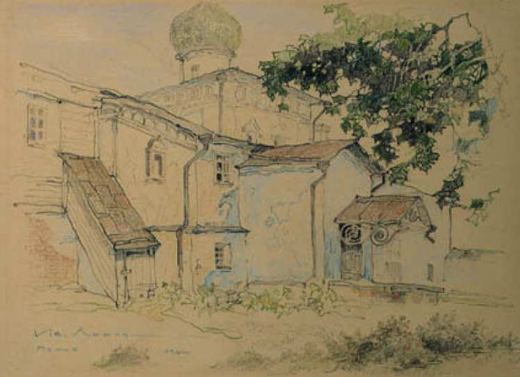
Exterior of a Church in Pskov
Ivan Andreyevich Lvov
1921 · Pastel on paper · 21 x 16 cm
Ivan Andreyevich Lvov is a still only partially documented artist whose classification requires particular care. The source list identifies him with the life dates 1859-1933 and refers to repeated exhibitions as well as works in the State Tretyakov Gallery and other collections. At the same time, Russian art-market and reference sources contain several artists with identical or similar names, including an Ivan Andreyevich Lvov with the dates 1904-1942. For a public catalogue, the precise identification of the correct artist is therefore essential. Under the identity used in the collection, 1859-1933, Lvov appears as a painter and graphic artist of the transition from the late nineteenth century to the early Soviet period.
Market entries describe him as an artist whose works were represented in exhibitions of various artists' societies and whose works are held by the Tretyakov Gallery and further museum and private collections. These references suggest that Lvov is not treated as an isolated amateur, but as an exhibition-active artist within an organised artistic milieu. The art-historical challenge is not to inflate his profile artificially. For less canonised artists, the reconstruction of exhibition and association contexts is itself significant. In Russia around 1900 and after 1917, artists' associations formed central networks of visibility. They enabled participation in the art market, thematic exhibitions and debates about realism, modernisation and the social function of art. If Lvov appeared in such contexts, his work is understood as part of this broader exhibition culture.
Known or traded works point toward drawing and figurative compositions; examples with antique or historical motifs indicate an interest in narrative scene, figure and composition. Without a secure body of works, however, no fixed stylistic attribution is made. What matters is to take Lvov seriously as an artist of the second tier: such artists help us understand the breadth of an artistic landscape in which not only famous masters, but also exhibitors, draughtsmen, association members and regional collection histories shaped the overall picture. For I tesori della Russia, Lvov is relevant precisely because of this intermediate position. A high-quality collection of Russian art does not show only canonised names, but also those artists who were present in exhibitions, whose works circulated in collections and who sustained the everyday reality of the art system.
Lvov makes it possible to present Russian art history as a network of more and less visible positions. At the same time, his profile must remain source-critical until the specific collection object, through signature, provenance and comparison with securely attributed works, supports one of the possible Lvov identities.
Lvov's work can currently be described only with caution. The available references mention painting, graphic art and exhibition participation. Individual market traces point to figurative, historical or compositional works. This permits a tentative placement within a realist or academically shaped environment, but not a definitive stylistic classification. Art-historically, Lvov is understood as a representative of less canonised but collection-historically important exhibition culture. His significance lies less in revolutionary stylistic innovation than in his presence within artists' societies and collections. This level is important for reconstructing Russian art around 1900 and in the early Soviet period.
For I tesori della Russia, Lvov is an example of how a serious collection makes visible secondary positions that still require deeper research. His profile provides context without creating false certainty. Curatorially, he is presented as a representative of the broad Russian exhibition landscape and as a case for precise provenance and identity research.