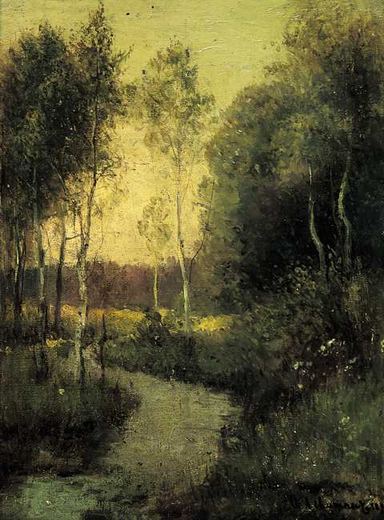
Birches Along the Bank
Isaac Ilyich Levitan
1896 · Oil on canvas · 29 x 39 cm
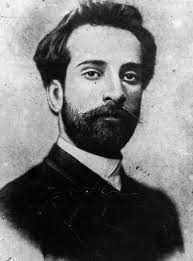
Isaak Iljitsch Lewitan is one of the central figures of nineteenth-century Russian art and is widely regarded as one of the greatest masters of landscape painting. His name is inseparable from the concept of the mood landscape: a landscape in which nature is not merely depicted, but understood as a bearer of feeling, time, memory and inner tension. Lewitan did not paint landscapes as simple topographical views. In his finest works, modest motifs - paths, rivers, birches, autumn light, monasteries, stretches of the Volga or wide skies - become images of deep psychological and cultural resonance. Born in Kibarty in present-day Lithuania, Lewitan came to Moscow as a child. His training at the Moscow School of Painting, Sculpture and Architecture brought him into contact with Alexei Savrasov, Vasily Polenov and the living realist landscape tradition of the Peredvizhniki.
Savrasov's influence was decisive: from him, Lewitan inherited the idea that the Russian landscape draws its power not from spectacular motifs, but from inward mood, light and the relation between human experience and nature. At the same time, Lewitan developed this approach to an unprecedented level of painterly and emotional concentration. Lewitan's work is marked by extraordinary concentration. He often chooses seemingly simple fragments: a forest path, a bend in the Volga, an autumn day, still water, a monastery beyond trees. Yet from these motifs he creates images of existential intensity. Colour, light and composition do not function illustratively, but almost musically. Landscape becomes the expression of a spiritual atmosphere without becoming cryptically Symbolist.
This is his special position: Lewitan remains a realist, but his realism is already psychological, poetic and modern. For I tesori della Russia, Lewitan is a key position. Russian landscape painting cannot be told adequately without him. He joins the realist tradition of the Peredvizhniki with a quiet, almost metaphysical experience of nature. A work or profile by Lewitan in the collection therefore points not only to a major artist, but to a core of Russian artistic identity: landscape as a mirror of national, emotional and spiritual experience. His presence substantially raises the art-historical rank of any serious collection of Russian art.
Lewitan's pictorial language rests on extreme painterly condensation: muted tonal values, subtle transitions of light, open horizons, rhythmic groups of trees and a strong emotional structure. He made the Russian landscape a bearer of mood and meaning without overloading it allegorically. His painting is at once realist, lyrical and modern; it continues to shape the perception of Russian nature painting.
The source list names the Russian Museum, the Tretyakov Gallery, Plyos, the Tver and Saratov art museums, Vladivostok, Kazan, Perm, Vologda and the Israel Museum. For I tesori della Russia, Lewitan forms an art-historical anchor: he legitimises and orders the entire landscape section of the collection and connects it with one of the internationally recognised summits of Russian painting.