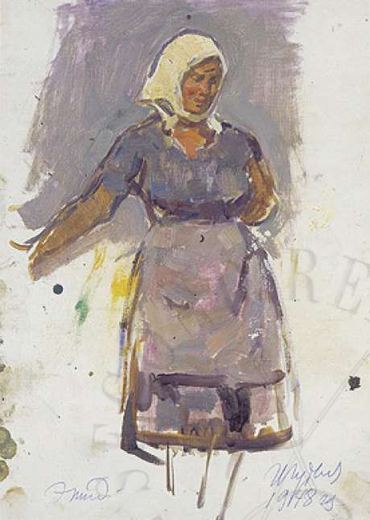
Peasant Woman
Iosif Mikhailovich Gurvich
1948 · Oil on canvas-covered cardboard · 23 x 31 cm
Iosif Mikhailovich Gurvich is one of those positions in Soviet art that are especially interesting for an informed audience because they complicate the official history of Socialist Realism. He was a painter, graphic artist, monumental artist and teacher, trained in the milieu of Odessa and later active in Moscow. In reception he is sometimes described as a “Soviet Cézannist” or “Russian Cézanne”. Such labels is used with caution, but they point to a real core of his work: Gurvich was deeply concerned with pictorial structure, colour, volume and the painterly organisation of the visible world. Gurvich was born in Chișinău in Bessarabia in 1907. He came early to Odessa, an important southern art centre with its own colour-intensive tradition. As early as 1919 he worked in Odessa Yug-ROSTA, in the environment of early Soviet agitational art.
He then studied at art schools and at the Odessa Art Institute, among others with Teofil Fraerman. This Odessa milieu was marked by a particular openness: French modernism, Jewish culture, southern Russian light conditions and Soviet optimism of departure met one another there. From 1929 Gurvich was a member of the Association of Revolutionary Art of Ukraine. From 1930 to 1932 he taught at the Odessa Art Institute before moving to Moscow. His later career unfolded within a field of tension characteristic of many Soviet artists: on one side, thematic and institutional proximity to Soviet art policy; on the other, an independent painterly sensibility that did not exhaust itself in illustrative ideology. During the Second World War, Gurvich served in the army. After 1945 he taught in an art workshop for war-disabled artists and at the same time in a children's art school.
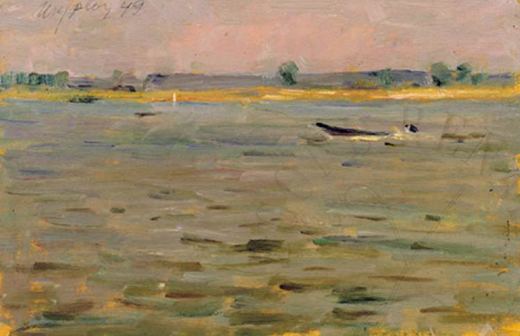
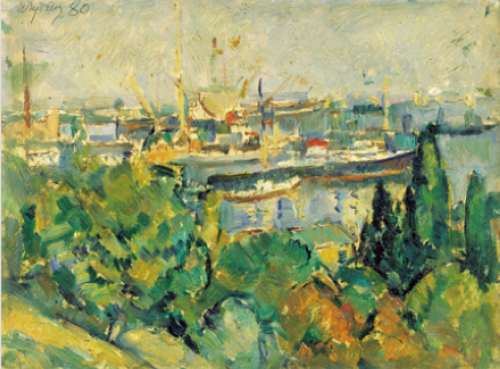
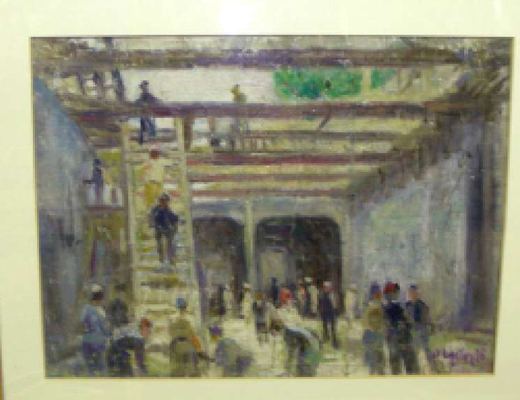
This biographical stage is important for his classification: Gurvich represents a generation whose art was shaped by revolution, war, reconstruction and pedagogical responsibility. His painting is not the radical Avant-Garde of the 1910s, but it preserves a serious interest in painterly structure. His oeuvre includes portraits, still lifes, landscapes, thematic compositions, posters and monumental projects. His subjects range from worlds of labour to metro and construction motifs, as well as historical and everyday scenes. In the strongest works, Soviet subject matter is not treated only narratively, but composed through weight, colour resonance and corporeality. Objects stand in space as if they possessed painterly density; colour models both form and atmosphere.
Gurvich's artistic quality lies in the union of structure and sensuousness. His pictures are often weightier, more corporeal and more colour-conscious than merely illustrative Soviet thematic painting. The reference to Cézanne therefore implies less direct imitation than an interest in the constructive order of the image: volume, the weight of planes, and the relationship between object and pictorial architecture. As an artist of the Odessa-Moscow corridor, Gurvich reveals an important geographical dimension of Soviet art. He connects the southern colour tradition with the institutional world of Moscow. For an ambitious collection he is interesting precisely for that reason: he opens a view onto the transitional areas between the afterlife of the Avant-Garde, official art, private painting and pedagogical culture.
For I tesori della Russia, Gurvich appears as a deliberately differentiating position within Soviet art. He enables the collection to avoid forcing Soviet art into a simple schema of Avant-Garde versus Socialist Realism. His work shows a third level: painterly independence within Soviet thematic and institutional spaces. Because the source list names primarily private collections, especially careful provenance and work-specific verification are advisable for Gurvich. At the same time, precisely this closeness to collecting can be attractive: Gurvich is an artist for connoisseurs, not only for the canon.