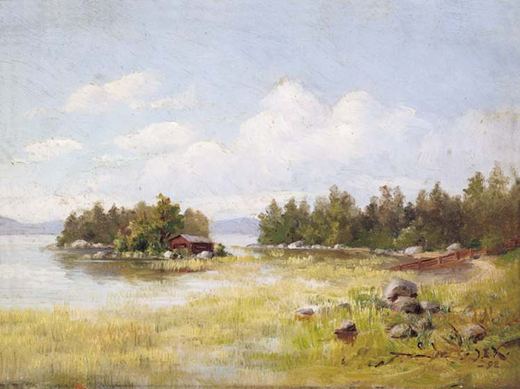
Small House by the Lake
Iosif Evstafievich Krachkovsky
1892 · Oil on panel · 24 x 18 cm
Iosif Evstafievich Krachkovsky was a Russian landscape painter of the late nineteenth and early twentieth centuries and an academician of the Imperial Academy of Arts. He was born in Warsaw in 1854 and died in Cadenabbia on Lake Como in 1914. His biography connects the Russian academic tradition with a mobile European artistic existence: training in Saint Petersburg, study journeys to Western Europe, and repeated stays in Italy, France, Crimea and Ukraine. Krachkovsky studied at the Imperial Academy of Arts and received his formation as a landscape painter under, among others, Mikhail Klodt. He was already named an academician in 1884. This academic recognition is essential to his position: Krachkovsky does not belong to radical modernism, but to a highly professional landscape tradition in which compositional order, atmospheric effect and technical assurance were decisive. His travels expanded his range of subjects. In addition to northern and Russian landscapes, he painted motifs from Crimea, Ukraine, the Volga region and Italy. He therefore stands within an international landscape culture in which Russian artists combined their own perception of nature with southern light, Mediterranean topography and Western European travel experience.
Krachkovsky's painting is characterised by atmospheric balance. He favoured transitional moods - evening, twilight, early spring, late summer, the moment before a storm - in other words, moments in which landscape becomes not merely a place, but a state. The pictorial space remains legible and traditionally organised, while the primary interest lies in the mutability of light, air and weather. His best works show that academic landscape painting around 1900 was not simply frozen in convention, but developed a differentiated sensitivity to natural mood. Crimean and Italian motifs allowed him a different chromatic register from the northern landscape; Russian motifs, in turn, preserved the quieter tonal foundation characteristic of landscape culture in the second half of the nineteenth century. Art-historical classification: Art-historically, Krachkovsky stands between the Academy, the realist landscape school and international travel painting. He was a member or participant in important artistic institutions, and his works are held, among other collections, by the Russian Museum, the Tretyakov Gallery and the Museum of the Russian Academy of Arts. For a collection of Russian art, he is important because he represents the museum-recognised, academically grounded landscape painting of the period around 1900.
Within I tesori della Russia, Krachkovsky can serve as a cultivated complement to the great landscape positions. Whereas Shishkin stands for monumental natural force and Levitan for existential mood, Krachkovsky shows the academically trained, internationally travelling variant of Russian landscape art. His work helps make the collection's nineteenth-century breadth more art-historically convincing.