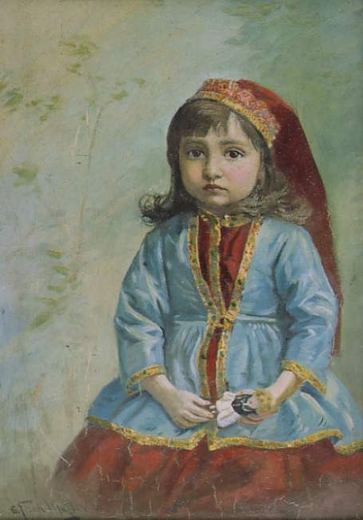
Girl in Georgian Costume
Gustav Alfred Müller
1898 · Oil on wood panel · 21 x 32 cm
Within I tesori della Russia, Gustav Alfred Müller belongs to those artists whose relevance derives less from a canonical position in Russian art history than from the wider European field in which Russian, German and Central European collection histories of the nineteenth and twentieth centuries intersect. The source list names him as Gustav Frank Müller and also specifies the spelling Gustav Alfred Müller. An artist Gustav Alfred Müller, with the life dates 1895-1978, is institutionally documented in the Kunstsammlungen Chemnitz, where works such as a 1924 artist portrait and the 1925 landscape Rabenauer Grund are recorded. The available museum references indicate a painter rooted in the Central German art milieu. His work appears to move between portrait, landscape and a soberly constructed approach to the figure.
This does not make him a central Russian artist within a collection of Russian and Eastern European relevance; it makes him an interesting marginal and comparative case. He points to a collection reality in which works of Russian, Baltic, German and Central European provenance often circulated, were collected and were exhibited together. For a public catalogue, Müller is therefore not artificially elevated into a Russian artist. His profile becomes stronger through precise classification as a German twentieth-century painter whose presence in the collection opens a broader cultural-historical frame. In high-level collections, such peripheral positions matter because they make visible the dialogues between regional painting, European modernity and the collection pathways of Russian art.
Müller's work, insofar as it can be grasped through museum object records, suggests a painterly position that does not rely on avant-garde programmatics, but on material, composition and disciplined motif treatment. The Chemnitz holdings record oil painting on coarse canvas or canvas, pointing to a robust, pictorial handling that gives portrait and landscape a material presence. Art-historical classification: In the context of the collection, Müller is understood as an artist from the European surrounding field. His contribution does not lie in revolutionary stylistic invention, but in documenting a generation of painters who worked after the upheavals of the early twentieth century between regional identity, academic formation, modern simplification and bourgeois pictorial culture. He therefore provides a meaningful counterpoint to the more programmatic Russian positions in the overall list.
For I tesori della Russia, Müller has a curatorial function as a bridge and context figure. He extends the view from the Russian core of the collection to the actual European resonance spaces in which Russian art was collected, compared and received. The references to Chemnitz, Bautzen, Dresden, Zittau and Berlin gallery contexts indicate that the entry touches a Central German collection and exhibition history. In the public catalogue, Müller therefore appears as a deliberately source-critical artist: not as a Russian master, but as a European comparative position within a collection body that can be read beyond strict national boundaries.